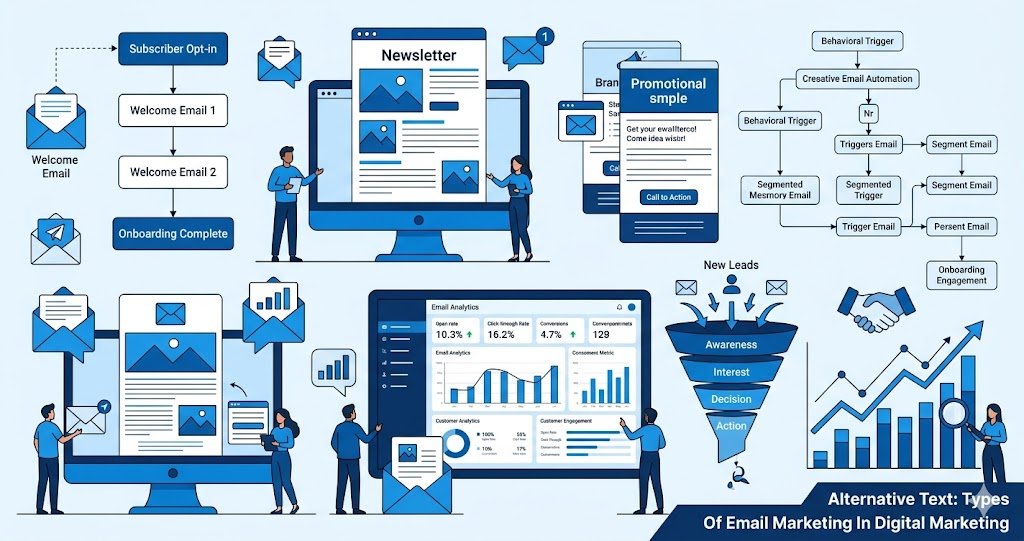
Types Of Email Marketing In Digital Marketing
Types Of Email Marketing In Digital Marketing neha P Verma
Email marketing remains one of the most effective digital marketing strategies for businesses of all sizes. Despite the rise of social media and other communication channels, email continues to deliver exceptional ROI, helping brands connect directly with customers, build trust, and increase sales.

According to marketing studies, email marketing generates significantly higher returns compared to many other digital marketing channels. However, success depends on understanding the different types of email marketing and using them strategically.

In this guide, you’ll learn the most important types of email marketing in digital marketing and how each can help your business grow.

What Is Email Marketing?

Email marketing is a digital marketing strategy that involves sending emails to prospects and customers to promote products, share valuable information, nurture relationships, and drive conversions.
Businesses use email marketing to:

  • Increase brand awareness
  • Boost sales
  • Build long-term relationships
  • Drive website traffic

Why Is Email Marketing Important?

Email marketing offers several advantages:

✔ Direct communication with customers
✔ Cost-effective marketing channel
✔ High return on investment
✔ Personalized customer experiences
✔ Improved customer loyalty
✔ Better conversion rates

If you’re not using email marketing effectively, you could be missing valuable opportunities to grow your business while competitors gain an advantage.

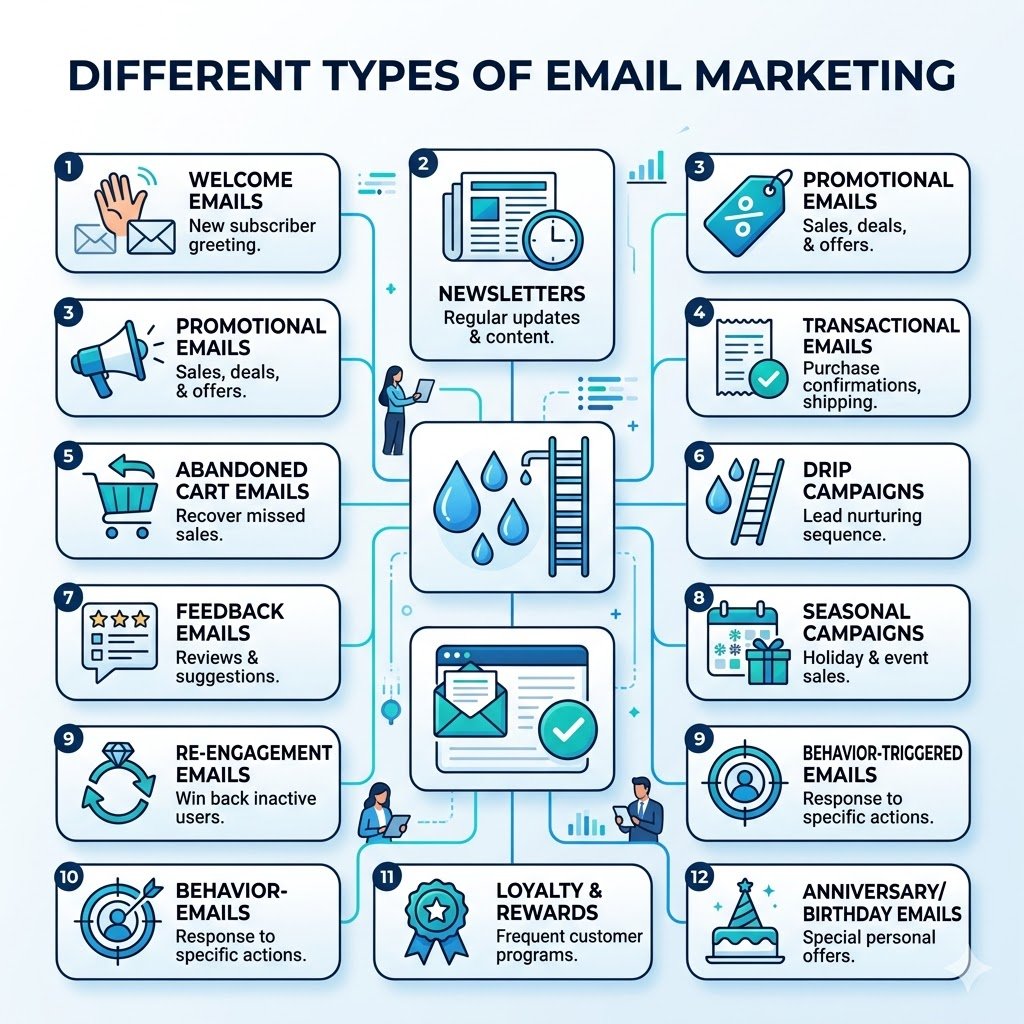
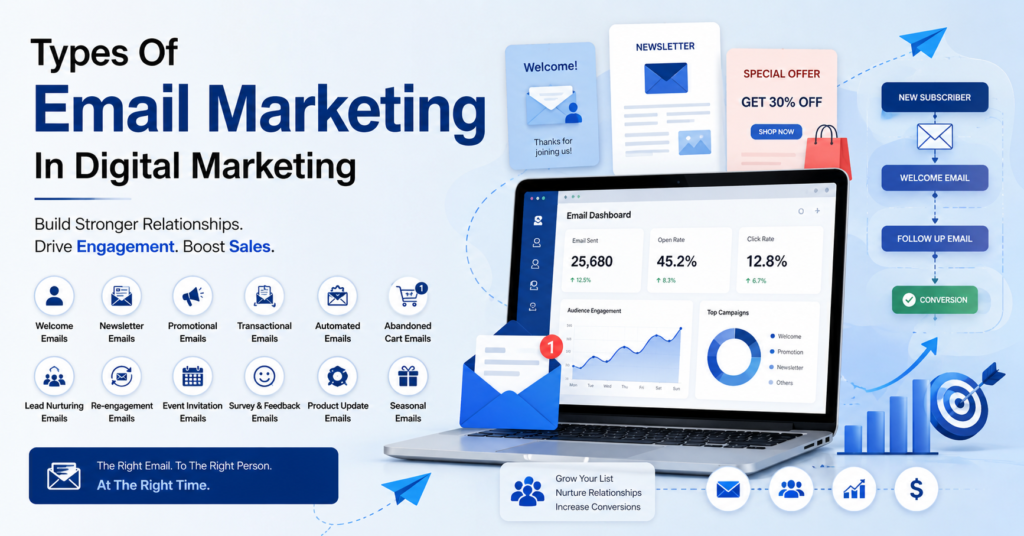
12 Types Of Email Marketing In Digital Marketing

  1. Welcome Emails

Welcome emails are sent immediately after someone subscribes to your email list.

Purpose:

  • Introduce your brand
  • Set customer expectations

Benefits:
 

  • High open rates
  • Strong engagement
  • Increased trust

Example:
 

“Welcome to our community! Here’s your exclusive discount and guide to getting started.”

  1. Newsletter Emails
Newsletter emails provide regular updates to subscribers.
Purpose:

  • Share company news
  • Educate customers
  • Maintain engagement

Benefits:


  • Builds relationships
  • Keeps your audience informed
  • Drives website traffic

Example:


Weekly marketing tips, industry updates, and company announcements.

  1. Promotional Emails
Promotional emails are designed to encourage purchases.

Purpose:

  • Promote products or services
  • Announce special offers
  • Increase sales

Benefits:

  • Generates revenue
  • Increases conversions
  • Creates urgency

Example:


“Limited-Time Offer: Get 50% Off Today Only!”

  1. Transactional Emails

Transactional emails are triggered by customer actions.
Purpose:

  • Confirm purchases
  • Provide receipts
  • Share account information

Benefits:
 

  • Improves customer experience
  • Builds trust
  • Provides essential information

Examples:


  • Order confirmations
  • Shipping updates
  • Payment receipts
  1. Lead Nurturing Emails
Lead nurturing emails guide prospects through the buying journey.
Purpose:

  • Educate potential customers
  • Build trust
  • Encourage conversions

Benefits:


  • Higher sales opportunities
  • Better customer relationships
  • Increased conversion rates

Example:


A series of emails explaining product benefits and customer success stories.

  1. Abandoned Cart Emails
These emails remind customers about products left in their shopping cart.

Purpose:


  • Recover lost sales
  • Encourage order completion

Benefits:


  • Higher conversion rates
  • Increased revenue

Example:


“You left something behind! Complete your purchase now and enjoy free shipping.”

  1. Re-Engagement Emails
Re-engagement emails target inactive subscribers.

Purpose:


  • Win back inactive users
  • Increase engagement

Benefits:


  • Reduces subscriber loss
  • Improves list performance

Example:


“We Miss You! Here’s an exclusive offer to welcome you back.”

  1. Survey And Feedback Emails
These emails collect customer opinions and feedback.

Purpose:


  • Understand customer needs
  • Improve products and services

Benefits:


  • Better customer satisfaction
  • Valuable business insights

Example:


“Tell us about your experience and help us improve.”

  1. Event Invitation Emails
Event invitation emails promote webinars, workshops, and events.
Purpose:

  • Increase event attendance
  • Generate engagement

Benefits:


  • More registrations
  • Stronger audience relationships

Example:


“Reserve Your Seat For Our Free Digital Marketing Webinar.”

  1. Product Update Emails
These emails inform customers about new features or improvements.
Purpose:

  • Announce updates
  • Increase product adoption

Benefits:


  • Improved user experience
  • Greater customer retention

Example:


“Introducing Our Latest Features Designed To Save You Time.”

  1. Seasonal Emails
Seasonal emails are sent during holidays and special occasions.

Purpose:


  • Promote seasonal offers
  • Increase holiday sales

Benefits:


  • Higher customer engagement
  • Increased revenue

Examples:


  • Diwali campaigns
  • Christmas promotions
  • New Year discounts
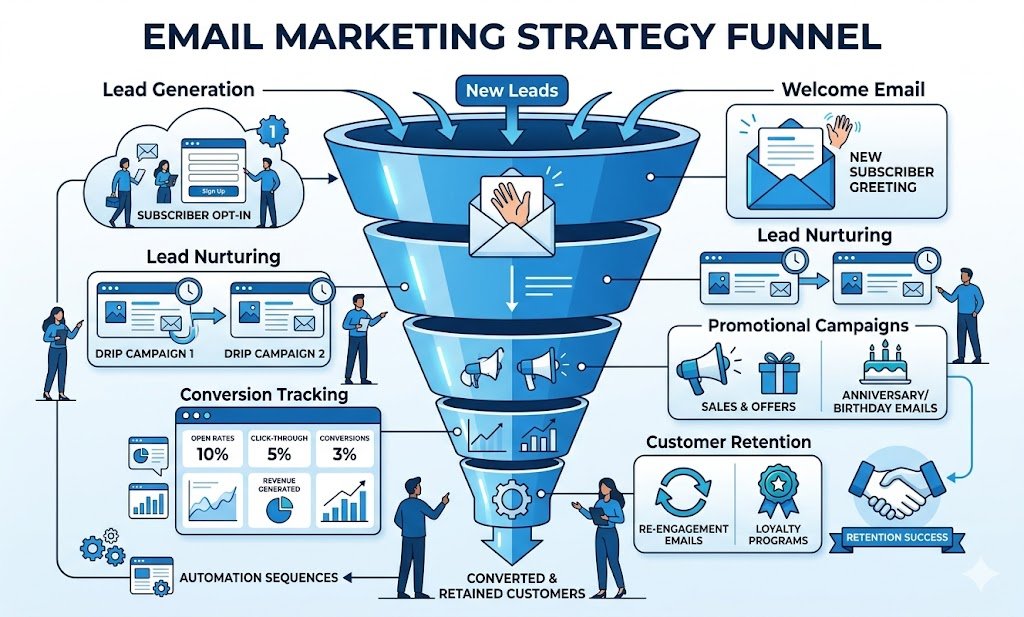
  1. Automated Drip Campaign Emails
Drip campaigns deliver a sequence of automated emails over time.

Purpose:


  • Guide subscribers through a journey
  • Deliver information gradually

Benefits:


  • Saves time
  • Improves engagement
  • Increases conversions

Example:


A 7-day onboarding email series for new customers.
Types Of Email Marketing In Digital Marketing Neha P Verma
Full Name


Benefits Of Different Types Of Email Marketing

Email marketing isn’t a one-size-fits-all channel. Different campaigns serve entirely different purposes—some build trust over months, while others trigger immediate sales.

When you align the right type of email with the right business goal, it dramatically changes your performance metrics, from open rates to conversion percentages.
Here is a detailed breakdown of the primary types of email marketing and the unique benefits each one brings to your strategy.

  1. Welcome Email Sequences

Sent automatically the moment someone signs up for a newsletter, creates an account, or downloads a resource.

  • The Big Benefit: Unmatched Engagement. Welcome emails consistently pull the highest open rates of any email type—often averaging 60% to 80%. This is your absolute best window to introduce your brand voice, set expectations, and deliver immediate value while your brand is top-of-mind.
  • Key Advantages:
  • Establishes Whitelisting: Getting users to open and click your first email signals to inbox providers (like Gmail or Outlook) that your future emails belong in the primary inbox, not the spam folder.
  • Immediate Conversion Opportunities: Offering a small, exclusive first-time discount or a high-value resource can convert a cold subscriber into a paying customer within minutes of signup.

  1. Educational & Value-Driven Newsletters

Regularly scheduled emails (weekly, bi-weekly, or monthly) that focus on industry insights, tips, curated content, or company updates.

  • The Big Benefit: Long-Term Brand Authority & Retention. Instead of constantly asking for a sale, newsletters give you a platform to provide continuous value. When subscribers consistently get helpful insights from you, you become their go-to expert.
  • Key Advantages:
  • Keeps Your Brand Top-of-Mind: Even if a subscriber isn’t ready to buy today, regular touches ensure you are the first company they think of when they are ready.
  • Drives Consistent Website Traffic: Curating snippets of your latest blog posts or case studies with links back to your site creates a reliable, recurring traffic engine that doesn’t rely on paid ads.

  1. Promotional & Product Launch Campaigns

One-off or short-series emails designed to push a specific offer, seasonal sale, or new feature/product launch.
  • The Big Benefit: Rapid Revenue Generation. When you need to clear inventory, hit end-of-month targets, or make a splash with a new product, promotional emails deliver fast, direct ROI.
  • Key Advantages:
  • Leverages Urgency and Scarcity: Features like countdown timers, flash sales, or limited-quantity offers create a psychological nudge that prompts quick decision-making.
  • Highly Trackable Sales: Because these campaigns use specific links and coupon codes, you can calculate the exact dollar amount of revenue generated per email sent.

  1. Behavioral & Behavioral Triggered Emails

Automated messages sent based on specific actions a user takes (or fails to take) on your website. Classic examples include abandoned cart emails, browse abandonment, and post-purchase follow-ups.

  • The Big Benefit: Hyper-Relevance. Because these are tied to real-time user behavior, they are highly contextual. A user who just left a pair of shoes in their cart is infinitely more likely to open an email about those shoes than a generic sales blast.
  • Key Advantages:
  • Recovers Lost Revenue: Abandoned cart sequences recover an average of 10% to 15% of lost sales that would have otherwise vanished.
  • Drives Secondary Purchases: Post-purchase emails (“People who bought this also liked…”) are incredibly effective for cross-selling and upselling, increasing your customer lifetime value (LTV).

  1. Re-Engagement & Win-Back Campaigns

Targeted specifically at subscribers who haven’t opened or clicked an email from you in a set period (e.g., 90 to 180 days).
  • The Big Benefit: List Hygiene and Cost Efficiency. Most email marketing platforms charge you based on the total number of subscribers. Win-back campaigns help you identify who is still interested so you can cleanly remove the dead weight.
  • Key Advantages:
  • Protects Deliverability: Sending emails to thousands of inactive accounts tells inbox algorithms that your content isn’t wanted, which hurts your overall sender reputation. Cleaning your list ensures your emails stay out of the promo tab.
  • Last-Chance Conversions: A bold “We miss you” email paired with an aggressive incentive can reactivate a segment of your audience that you had otherwise lost.
Strategy Summary Matrix

Email Type

Primary Goal

Core Metric to Watch

Frequency

Welcome Sequence

Onboarding & Trust

Open Rate / CTR

Automated (Immediate)

Newsletters

Authority & Retention

Click-Through Rate (CTR)

Recurring (Weekly/Monthly)

Promotional

Direct Sales & Revenue

Conversion Rate / ROI

Campaign-Dependent

Triggered (e.g., Cart)

Revenue Recovery

Conversion Rate

Automated (Behavior-Based)

Re-Engagement

List Cleanliness

Open Rate / Unsubscribe Rate

Quarterly / Biannual

Types Of Email Marketing In Digital Marketing Neha P Verma

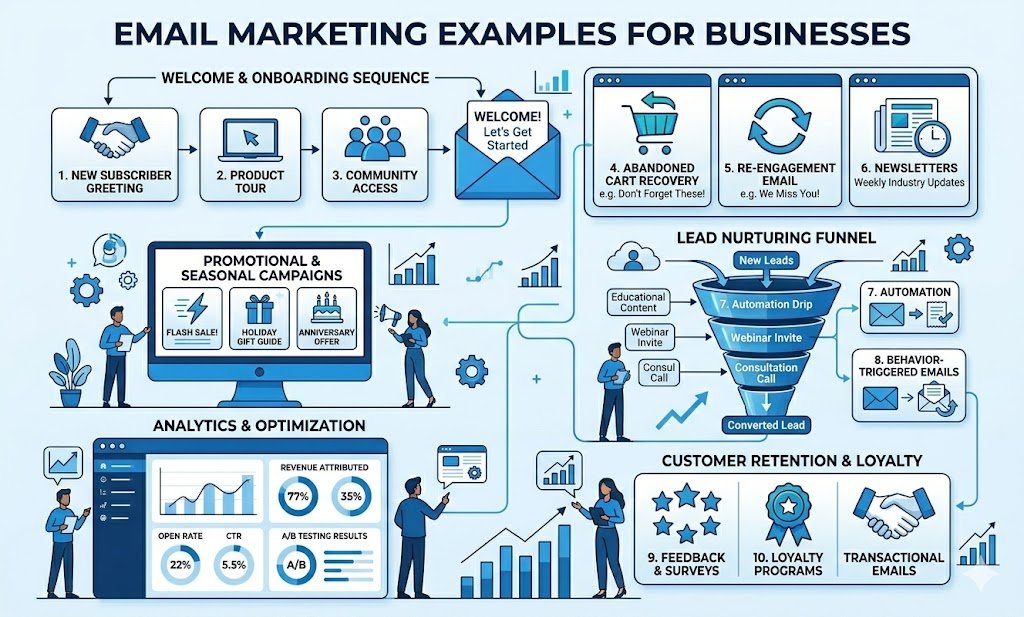
Email Marketing Examples For Businesses


To see how these different types of email marketing work in the real world, let’s look at a few practical, brief examples of how distinct businesses use them to drive results.

  1. The Welcome Email: E-Commerce Brand

  • The Scenario: A user visits an online clothing store and signs up for the newsletter to get a 10% discount code.
  • The Email:
  • Subject Line: Welcome to the family! Here is your 10% off code 🎁
  • The Content: A warm greeting delivering the promised discount code upfront. It briefly highlights the brand’s core mission (e.g., “Sustainably sourced fabrics”) and features a clear, bold call-to-action (CTA) button reading “Shop Best Sellers.”
  • The Goal: Move the subscriber from a browser to a first-time buyer immediately.

  1. The Educational Newsletter: B2B SaaS (Software) Company

  • The Scenario: A project management software company sends a monthly digest to its user base and leads.
  • The Email:
  • Subject Line: 3 workflow bottlenecks killing your team’s productivity 📉
  • The Content: Instead of selling the software, the email provides value by breaking down three common workplace productivity mistakes. Each point has a brief explanation and links back to a detailed guide on the company’s blog. A small footer mentions how their tool automates these exact bottlenecks.
  • The Goal: Establish industry authority, build trust, and drive consistent website traffic.

  1. The Behavioral Trigger: Abandoned Cart

  • The Scenario: A customer adds a coffee maker to their cart on an appliance website but leaves the site before checking out.
  • The Email (Sent 2 hours later):
  • Subject Line: Did you forget something? Your coffee maker is waiting.
  • The Content: A personalized dynamic email displaying an image of the exact coffee maker they left behind. It includes a snippet of a 5-star customer review praising how easy the machine is to clean, and a direct link to return to their cart.
  • The Goal: Create a smooth path back to the checkout page to recover a high-intent, lost sale.

  1. The Promotional Campaign: Service-Based Business (e.g., Digital Agency)

  • The Scenario: A marketing agency wants to book more client strategy audits before the end of the quarter.
  • The Email:
  • Subject Line: Claim your Q3 Growth Blueprint (Only 5 spots left) 🚀
  • The Content: The email addresses a specific pain point (e.g., “Are your Facebook ads hitting a wall?”). It offers a free 30-minute growth audit to the first five businesses that reply or click a scheduling link. It uses urgency by stating the offer expires on Friday.
  • The Goal: Generate quick, high-quality inbound leads for the sales team.

  1. The Win-Back Email: Subscription/Membership Business

  • The Scenario: An online fitness platform notices a user hasn’t logged in or opened an email in 90 days.
  • The Email:
  • Subject Line: We miss you, Sarah. Here is a free week on us.
  • The Content: A highly personalized email acknowledging that it’s been a while. It introduces 3 new popular workout programs that were launched during their absence and offers a friction-free “Click to reactivate 7 days free” link.
  • The Goal: Re-engage an inactive user and protect the email sender’s reputation by filtering out truly dead accounts if they don’t respond.
Types Of Email Marketing In Digital Marketing Neha P Verma

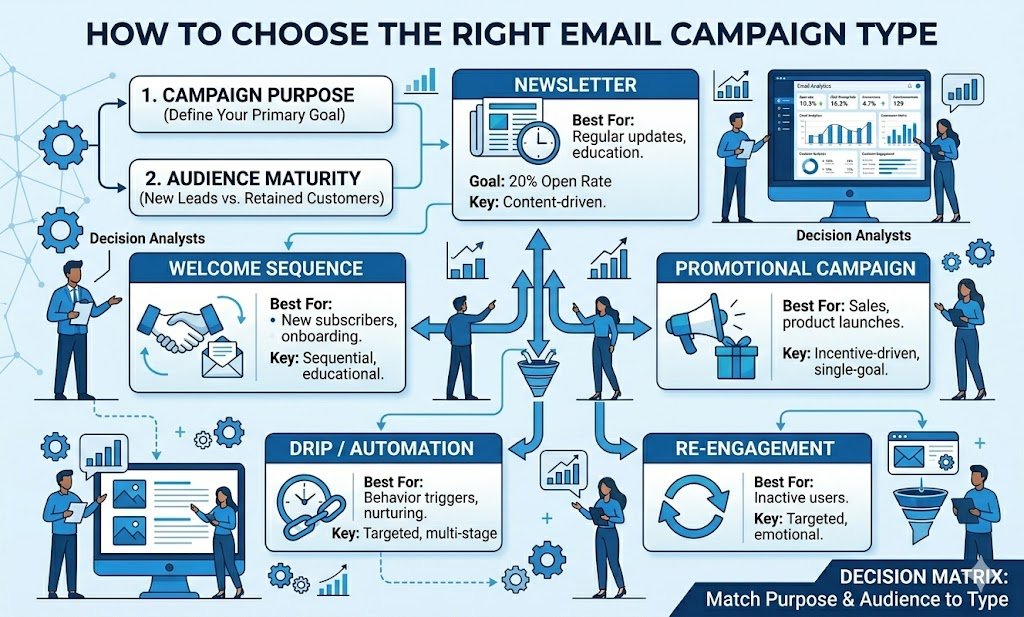
How To Choose The Right Email Campaign Type


Choosing the right email campaign isn’t about guessing—it is entirely dictated by where your audience is in their customer journey and what specific business action you need them to take right now.

To pick the right type, you can use a simple three-step framework based on your current objective.

The 3-Step Selection Framework

Step 1: Identify Your Immediate Goal


Start by defining exactly what you want the email to achieve.

  • If you need to onboard a new subscriber, establish your brand identity, and make a strong first impression → Choose a Welcome Sequence.
  • If you need to nurture relationships, build long-term trust, or keep your audience engaged between sales → Choose an Educational Newsletter.
  • If you need to drive sudden revenue, launch a new product, or clear out specific inventory → Choose a Promotional Campaign.
  • If you need to capture revenue from direct actions (or lack of action) a user took on your website → Choose a Behavioral Trigger (e.g., Abandoned Cart).

Step 2: Align with the Customer’s Mindset


Match the email to what the user expects from you based on their current relationship with your business.

  • High Intent (Hot): If they just left an item in their cart or looked at a pricing page, they are primed to buy. Don’t send them a long educational newsletter; send an automated Triggered Email to remove friction and close the deal.
  • Neutral/Exploring (Warm): Regular subscribers who aren’t actively trying to buy right now will get annoyed by constant sales pitches. Keep them warm with regular Value-Driven Content.
  • Disengaged (Cold): For people who haven’t opened your emails in months, a standard promo blast won’t work. They need a dedicated Re-engagement/Win-back offer.

Step 3: Determine Your Resources & Frequency


Consider how much time you have to manage the campaign.

  • Set-and-Forget (Automated): Welcome series and behavioral triggers require upfront setup but run automatically in the background forever. They offer the highest ROI for the least ongoing effort.
  • Active Maintenance (Manual): Newsletters and flash sales require fresh content, copywriting, and scheduling every single time they go out.

Decision Matrix


When you aren’t sure which email to send, check your target audience segment against this quick matrix:

If your target audience is…
…And you want them to…
The Right Campaign Type is:
Brand new sign-ups
Learn who you are & buy a first product
Welcome Sequence
Existing, active subscribers
Stay loyal and remember your brand
Value Newsletter
High-intent website visitors
Finish a purchase they started
Behavioral Trigger
Your entire active database
Take advantage of a holiday/flash sale
Promotional Campaign
Inactive for 90+ days
Re-engage or cleanly opt-out
Win-Back Campaign
Types Of Email Marketing In Digital Marketing Neha P Verma


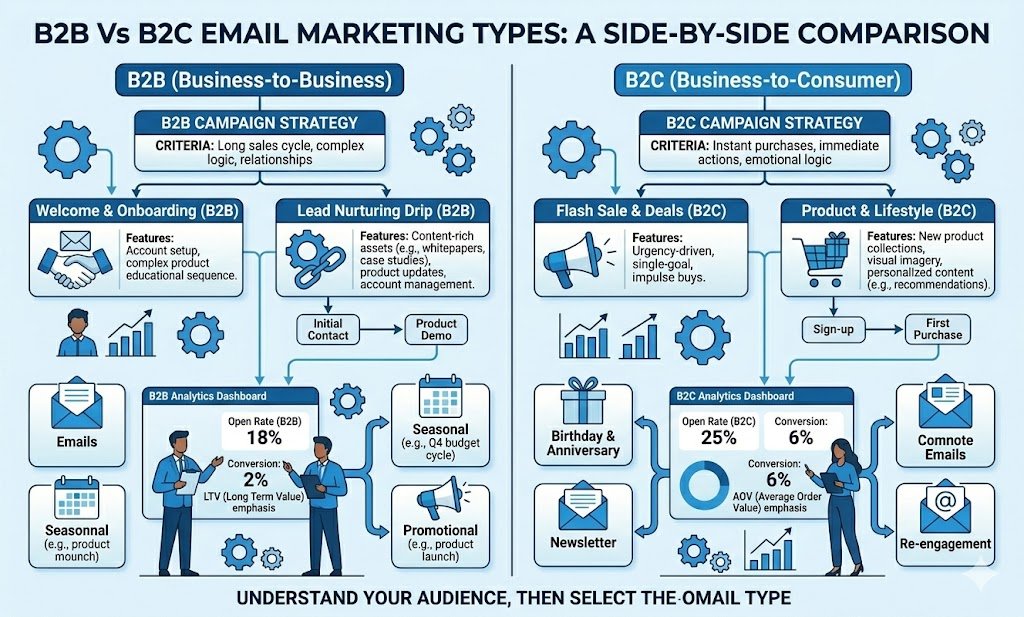
B2B Vs B2C Email Marketing Types

The core difference between B2B (Business-to-Business) and B2C (Business-to-Consumer) email marketing comes down to who is opening the email and how they make buying decisions.
While B2C emails focus on emotion, speed, and individual desire, B2B emails focus on logic, ROI, and building long-term professional trust.

1. B2B Email Marketing Types


In B2B, you are speaking to professionals who are spending company money. The sales cycles are long, often involving multiple decision-makers.
  • Lead Nurturing & Drip Campaigns:
  • What it is: A series of automated emails sent over weeks or months to educate a prospect.
  • Why it works: B2B buyers rarely purchase software or services on the first day. These emails solve problems, share whitepapers, and position your company as the logical expert.
  • Case Studies & Social Proof:
  • What it is: Emails highlighting how you helped a similar business solve a specific problem.
  • Why it works: B2B buyers need to mitigate risk. Seeing concrete data (e.g., “How Company X grew revenue by 35% using our tool”) proves ROI to their bosses.
  • Webinar & Event Invitations:
  • What it is: Direct invites to live educational events, workshops, or product demos.
  • Why it works: It drives high-value lead generation and allows prospects to interact with your team face-to-face before committing to a contract.

2. B2C Email Marketing Types


In B2C, you are speaking directly to individuals spending their own discretionary income. Purchases are often impulsive, emotional, and happen quickly.
  • Flash Sales & Promotional Discounts:
  • What it is: High-energy, time-sensitive offers (e.g., “30% off ends at midnight!”).
  • Why it works: It triggers FOMO (Fear Of Missing Out) and drives immediate, emotional buying decisions.
  • Cart & Browse Abandonment Triggers:
  • What it is: Automated reminders showing an exact product a user left behind.
  • Why it works: B2C shopping behavior is highly distracted. A quick nudge with a picture of the item—and maybe a free shipping code—instantly recovers the sale.
  • Loyalty & Birthday Rewards:
  • What it is: Personalized emails celebrating a customer milestone or offering a birthday gift.
  • Why it works: It makes the individual consumer feel valued, driving repeat purchases and building long-term brand affinity.

B2B vs. B2C Comparison At-A-Glance

Feature
B2B Email Marketing
B2C Email Marketing
Primary Driver
Logic, efficiency, and financial ROI
Emotion, status, and instant gratification
Tone & Voice
Professional, authoritative, and direct
Casual, energetic, and highly relatable
Sales Cycle Length
Long-term (Months to quarters)
Short-term (Minutes to days)
Decision Maker
Multiple stakeholders (HR, Tech, Finance)
Individual consumer (or single household)
Ideal Send Time
Tuesday–Thursday (During business hours)
Weekends & Evenings (Leisure time)
Types Of Email Marketing In Digital Marketing Neha P Verma

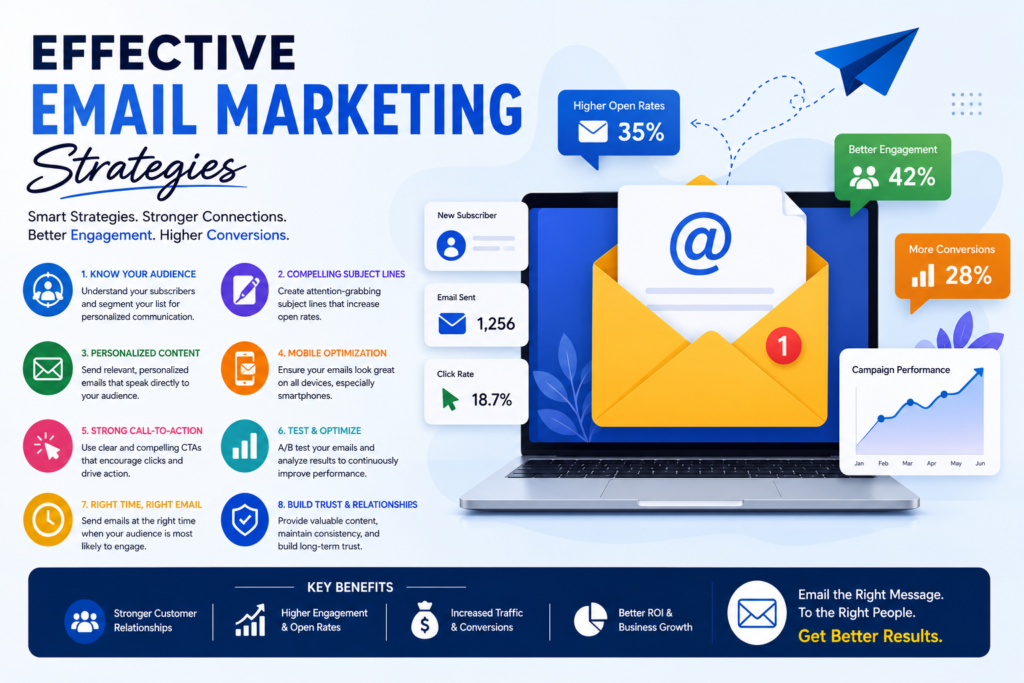
Effective Email Marketing Strategies


An effective email marketing strategy isn’t about blasting your entire list with the same message. It’s about sending the right message to the right person at the absolute right moment.
Here are the most reliable, high-yield email marketing strategies used by top-performing brands today.

1. Smart List Segmentation


Instead of treating your email list as one giant group, divide your subscribers into smaller segments based on shared characteristics.

  • How to apply it: Segment your audience by behavior (e.g., frequent buyers vs. users who haven’t bought yet), demographics (location, age), or engagement level (people who open every email vs. those who haven’t opened one in months).
  • The Payoff: Highly targeted emails receive up to 50% higher click-through rates because the content is explicitly relevant to the recipient.

2. Dynamic Personalization


Personalization goes way beyond just dropping a [First_Name] tag into the subject line. It means tailoring the actual content of the email to the individual recipient.


  • How to apply it: Use dynamic content blocks that change based on user data. Show product recommendations based on their past purchase history, change the local currency based on their location, or reference a specific industry if you are in B2B.
  • The Payoff: Emails with personalized recommendations drive significantly higher transaction rates and build stronger brand affinity.

3. Leverage “Set-and-Forget” Automated Triggers


Automated emails (or flows) are triggered by specific actions a user takes on your website. They work in the background 24/7 without requiring manual effort for each send.


  • How to apply it: At a bare minimum, set up four essential automations:

  1. Welcome Series: To greet and offer immediate value to new sign-ups.
  2. Abandoned Cart: Sent within 1-2 hours of a user leaving items behind.
  3. Browse Abandonment: Sent when someone views a specific product multiple times but doesn’t add it to their cart.
  4. Post-Purchase Upsell: Sent a week after a purchase to suggest complementary items.

  • The Payoff: Triggered emails generate over 2x higher open rates than standard promotional blasts because their timing is highly contextual.

4. Continuous A/B Testing


Never guess what works—let your data tell you. A/B testing involves sending two variations of an email to a small percentage of your list, seeing which one performs better, and automatically sending the winner to the rest of the audience.


  • How to apply it: Test one variable at a time:
  • Subject Lines: To optimize your Open Rates.
  • CTA Buttons: (e.g., “Buy Now” vs. “Learn More”) to optimize your Click-Through Rates.
  • Send Times: Test morning vs. evening, or weekdays vs. weekends.
  • The Payoff: Constant testing removes assumptions, resulting in steady, compounding improvements to your overall ROI.

5. Prioritize Mobile Optimization


Over 50% of all emails are opened on mobile devices. If your email looks broken, uses tiny text, or has stacked buttons that are impossible to tap with a thumb, it goes straight to the trash.


  • How to apply it: Use a single-column layout, keep subject lines under 40 characters so they don’t get cut off, use large font sizes (minimum 16px for body text), and ensure your Call-to-Action buttons are large and surrounded by plenty of whitespace.
  • The Payoff: A seamless mobile experience prevents unsubscriptions and captures on-the-go buyers.
Execution Checklist


Strategy
Difficulty
Execution Type
Focus Metric
Mobile Optimization
Easy
Template Design
Click-Through Rate
A/B Testing
Easy
Per Campaign
Open / Click Rate
Segmentation
Medium
Audience Rules
Relevance / Revenue
Automated Triggers
Hard
One-Time Setup
Lifetime Value (LTV)
Types Of Email Marketing In Digital Marketing Neha P Verma

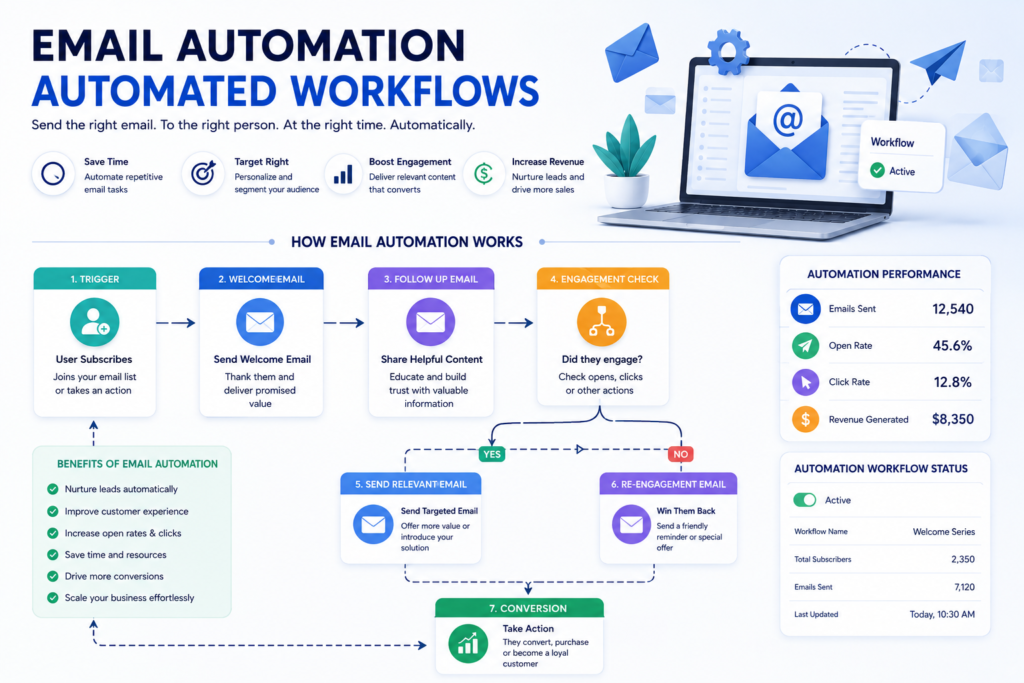
Email automation / Automated workflows

Email automation is the strategy of setting up emails that trigger automatically based on a user’s behavior, schedule, or data, rather than manually blasting a campaign to your entire list at once.
Instead of doing the work every time, you build the workflow once, and it runs in the background 24/7—delivering the right message at exactly the moment someone is most likely to engage.

How an Automated Workflow Works

Automated workflows rely on an If / Then logic model. Every workflow consists of three core components:

  1. The Trigger: The specific action that kicks off the sequence (e.g., a user downloads an e-book, joins a list, or abandons a shopping cart).
  1. The Delay: The timed waiting period before an email goes out (e.g., wait 30 minutes, wait 2 days).
  1. The Action / Condition: The system checks a rule and sends a specific email based on that rule (e.g., If they bought the product, send a thank-you email; If they didn’t, send a reminder code).

The 4 Essential Automation Workflows

Almost every successful business relies on these four foundational automations:

1. The Welcome / Onboarding Series

  • Trigger: A user signs up for your newsletter or creates a free account.
  • The Flow: Send Email 1 immediately (delivering a discount or resource) Wait 2 days Send Email 2 (introducing your brand’s story or top values) Wait 3 days Send Email 3 (highlighting your best-selling products or top services).
  • Goal: Capitalize on peak user interest to turn a subscriber into a buyer.

2. The Shopping Cart Abandonment Flow

  • Trigger: A user adds an item to their online cart but leaves the website without checking out.
  • The Flow: Wait 1 hour Send Email 1 (A friendly reminder: “Did you forget something?”) Wait 24 hours Send Email 2 (Add social proof: “See what others are saying about this item”) Wait 24 hours Send Email 3 (Add a final incentive: “Finish checkout now for free shipping”).
  • Goal: Recover lost revenue from high-intent shoppers.

3. The Lead Nurturing / Drip Sequence

  • Trigger: A prospect downloads a free guide, case study, or resource (common in B2B).
  • The Flow: Send the resource immediately Wait 3 days Send an educational email solving a related problem Wait 4 days Share a client success case study Wait 3 days Invite them to book a brief consultation call.
  • Goal: Educate a cold lead over time until they are sales-ready.

4. Post-Purchase / Customer Loyalty Flow

  • Trigger: A customer completes a purchase.
  • The Flow: Send an immediate receipt and shipping info Wait 7 days (after delivery) Send product care tips or how-to guides Wait 14 days Ask for a product review Wait 30 days Recommend a complementary product based on what they initially bought.
  • Goal: Increase Customer Lifetime Value (LTV) by driving repeat purchases.

Why Automation is a Game-Changer

  • Hyper-Relevance: Because the emails match the exact action a user just took, their open and click rates are typically 2x to 3x higher than standard, manual promotional blasts.
  • Scalability: Whether you get 5 sign-ups a day or 5,000, the system handles them seamlessly without requiring extra staff or hours.

Constant Optimization: Once a flow is running, you can easily look at the data to see where people are dropping off and tweak a single subject line or call-to-action to maximize sales.

Types Of Email Marketing In Digital Marketing Neha P Verma

Click-through rate (CTR) & Open rates

Open Rate and Click-Through Rate (CTR) are the two most critical health metrics in email marketing. They act as your diagnostic tools: Open Rate tells you if your audience notices you, while CTR tells you if they care about what you’re saying.

1. Open Rate: The Hook


The Open Rate measures the percentage of delivered emails that were opened by your recipients.

  • How it’s calculated:

$$\text{Open Rate} = \left( \frac{\text{Unique Opens}}{\text{Total Emails Delivered}} \right) \times 100$$

  • What it actually measures: The effectiveness of your Sender Name, Subject Line, and Preheader Text
    (the snippet of text next to the subject line). If these aren’t compelling, your email gets skipped.
  • The Reality Check: Due to privacy updates like Apple’s Mail Privacy Protection (MPP), open rates are artificially inflated because some inbox providers automatically “open” images in the background. Treat open rates as a directional trend rather than an exact science.

2. Click-Through Rate (CTR): The Action


The CTR measures the percentage of delivered emails that resulted in a recipient clicking on a link, image, or call-to-action (CTA) button inside the email.

  • How it’s calculated:

$$\text{CTR} = \left( \frac{\text{Unique Clicks}}{\text{Total Emails Delivered}} \right) \times 100$$

  • What it actually measures: The quality of your Email Content, Design, and Offer Relevance. If people open your email but don’t click, your copy or offer didn’t match their expectations.
  • Why it matters more: CTR is a highly reliable, un-inflated metric. It directly correlates with website traffic, lead generation, and revenue.
Bonus Metric — CTOR (Click-to-Open Rate): This measures how many people clicked out of only those who opened the email ($\frac{\text{Clicks}}{\text{Opens}} \times 100$). It is the absolute best way to measure how engaging the inside of your email layout is, completely separate from your subject line quality.

Industry Benchmarks & Optimization


Metric

Average Benchmark

Main Lever to Improve It

Open Rate

15% – 25%

Build curiosity or urgency in the Subject Line. Clean out inactive subscribers to avoid the promo tab.

Click-Through Rate (CTR)

2% – 5%

Use a single, high-contrast CTA Button instead of plain text links. Focus the copy on user benefits.


Audience segmentation / Targeted lists


Audience segmentation is the practice of dividing your email list into smaller, targeted sub-groups based on specific criteria.
Instead of sending a generic “batch-and-blast” email to everyone, segmentation allows you to send highly relevant messages to specific people. According to industry data, segmented campaigns can drive up to a 760% increase in email revenue because consumers expect personalization.

The 4 Primary Types of Segmentation


1. Behavioral Data (What they do)


This is the most powerful form of segmentation because actions speak louder than demographics.

  • Examples: Frequent buyers, users who abandoned a shopping cart, subscribers who haven’t opened an email in 90 days, or people who clicked a link in a specific blog post.
  • How to use it: Send a VIP discount to your top 10% highest-spending customers, or a win-back offer to inactive subscribers.

2. Demographic Data (Who they are)


Basic factual characteristics about the individual subscriber.


  • Examples: Age, gender, job title, company size, or geographic location.
  • How to use it: A clothing brand might segment by gender to show relevant apparel lines, or a digital marketing agency might segment by job title (e.g., Founders vs. Marketing Managers) to tailor their pitch.

3. Psychographic Data (What they care about)

Their personal preferences, interests, values, and lifestyle choices.

  • Examples: Content preferences (e.g., prefers video over articles), industry interests, or specific pain points they selected during signup.
  • How to use it: A fitness brand can segment users interested in “Weight Loss” separately from those interested in “Marathon Training” to ensure they receive relevant workout tips.

4. Lifecycle Stage (Where they stand with your brand)

Where the subscriber currently sits within your marketing or sales funnel.

  • Examples: New leads who have never purchased, first-time buyers, repeat loyal customers, or expired subscribers.
  • How to use it: Send an educational onboarding series to new sign-ups, but push direct cross-sell offers to repeat buyers.

Why Targeted Lists Outperform Generic Blasts

  • Higher Deliverability: Inbox providers (like Gmail and Yahoo) monitor how users interact with your emails. Because segmented emails are highly relevant, people open and click them more often, signaling to algorithms that your emails belong in the primary inbox—not the spam folder.
  • Lower Unsubscribe Rates: When subscribers only receive content that directly applies to their needs or interests, they are far less likely to hit “unsubscribe” or flag your message as spam.
  • Maximum Budget Efficiency: Most email marketing platforms charge you based on the size of your subscriber database. Segmenting allows you to target only the subscribers most likely to convert for a specific promotion, reducing wasted email volume.


A/B testing email campaigns

A/B testing (or split testing) is the process of sending two slightly different versions of an email to see which one performs better.

Instead of guessing what your audience likes, you send Version A to a small slice of your list, Version B to another small slice, and then automatically send the winning version to the remaining majority of your subscribers.

The A/B Testing Workflow

Most email marketing platforms handle this using a Split-and-Send layout. Here is how a standard test works:
[ Your Total Email List ]       │       ├───► Send Version A (10% of list) ───┐       │                                      ├─► Wait 2-4 hours to see which wins       ├───► Send Version B (10% of list) ───┘       │       └───► Automatically send the WINNING email to the remaining 80% of the list

The 3 Key Elements You Should Test

To get clear, actionable results, only test one variable at a time. If you change both the subject line and the layout, you won’t know which change caused the improvement.

1. Subject Lines & Preheaders

  • What it measures: Open Rates.
  • What to test:
  • Length: Short and punchy (under 40 characters) vs. descriptive.
  • Tone: Curiosity-inducing (“You’re missing out…”) vs. Direct value (“Get 20% off today”).
  • Personalization: Including the recipient’s first name vs. no name.
  • Formatting: Using emojis vs. plain text.

2. The Call-to-Action (CTA)

  • What it measures: Click-Through Rate (CTR).
  • What to test:
  • Button Text: Action-oriented language (“Get My Blueprint”) vs. generic text (“Click Here”).
  • Placement: Placing the button at the very top of the email vs. at the very bottom.
  • Design: High-contrast colored buttons vs. minimalist plain-text links.

3. Email Content & Layout

  • What it measures: Click-to-Open Rate (CTOR) and Conversions.
  • What to test:
  • Visuals: An image-heavy, highly designed template vs. a plain, text-only email that looks like it came directly from a friend.
  • Length: A short 3-sentence teaser linking to a blog post vs. a long-form story written directly inside the body text.

3 Rules for a Successful A/B Test

  • Rule 1: Ensure Your Sample Size is Large Enough. If your email list is under 1,000 subscribers, a split test won’t yield statistically reliable data. For very small lists, it’s safer to test your entire list across consecutive weekly campaigns rather than splitting a single send.
  • Rule 2: Let the Test Run Sufficiently. Give the test at least 2 to 4 hours to gather data before the platform declares a winner. Most opens and clicks happen within the first few hours of hitting the inbox.
  • Rule 3: Test with an Actionable Goal. Don’t test just for the sake of testing. Test to solve a clear problem, such as: “Our open rates are low, let’s test dynamic emojis in the subject line to see if we can stand out in the inbox.”


Here is a fully SEO-optimized, Google-friendly article structure designed to rank for “Types Of Email Marketing In Digital Marketing” with engaging content, FAQs, image suggestions, and FOMO elements.

Best Practices For Email Marketing Success

To maximize results:

Segment Your Audience

Send relevant content to different customer groups.

Personalize Emails

Use names and customer-specific information.

Write Strong Subject Lines

Increase open rates with compelling headlines.

Optimize For Mobile

Ensure emails display properly on smartphones.

Include Clear Calls-To-Action

Guide readers toward the desired action.

Test And Improve

Continuously analyze performance and optimize campaigns.

Common Email Marketing Mistakes To Avoid

  • Sending too many emails
  • Ignoring audience segmentation
  • Using misleading subject lines
  • Not optimizing for mobile devices
  • Failing to monitor campaign performance
  • Purchasing email lists
Avoiding these mistakes can significantly improve your email marketing results.


The Future Of Email Marketing


Email marketing continues to evolve with:

  • Artificial Intelligence (AI)
  • Hyper-personalization
  • Predictive analytics
  • Interactive emails
  • Automation workflows
Businesses that adopt these innovations will gain a competitive advantage and achieve better engagement rates.

Types Of Email Marketing In Digital Marketing Neha P Verma

Frequently Asked Questions (FAQs)

1. What are the main types of email marketing?

The main types include welcome emails, newsletters, promotional emails, transactional emails, lead nurturing emails, abandoned cart emails, re-engagement emails, survey emails, event invitation emails, product update emails, seasonal emails, and drip campaigns.

2. Which type of email marketing generates the most sales?

Promotional emails and abandoned cart emails typically generate the highest sales and conversions.

3. Why are welcome emails important?

Welcome emails create a strong first impression, introduce your brand, and often achieve the highest open rates.

4. What is a drip email campaign?

A drip campaign is a series of automated emails sent over time to nurture leads and guide customers through the buying journey.

5. How often should businesses send marketing emails?

The ideal frequency depends on your audience, but most businesses send emails weekly, bi-weekly, or monthly.

Conclusion

Understanding the different types of email marketing in digital marketing is essential for building successful campaigns. From welcome emails and newsletters to promotional campaigns and automated drip sequences, each email type serves a specific purpose in the customer journey.

The most successful businesses combine multiple email marketing strategies to attract leads, nurture relationships, and drive sales. If you’re not leveraging these email types effectively, you’re likely leaving valuable revenue opportunities on the table.

Start implementing these email marketing strategies today and stay ahead of competitors who are already using email to grow their business.

Full Name
Scroll to Top