SEO Content Marketing Strategy: The Complete Guide to Driving More Traffic, Leads, and Sales in 2026
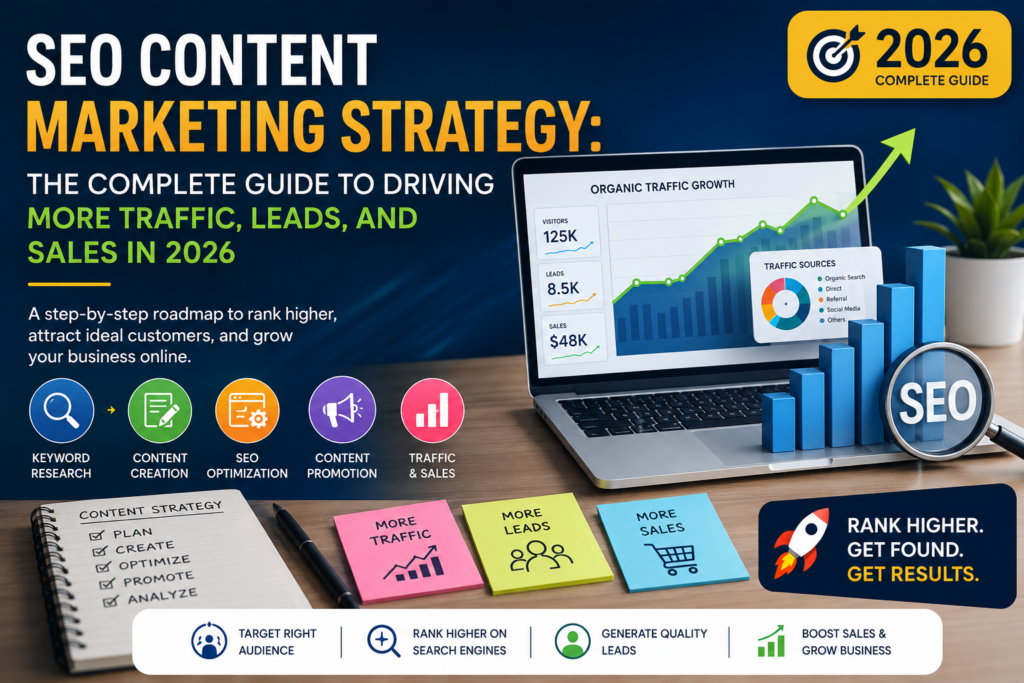
SEO Content Marketing Strategy: Why Businesses That Ignore It Are Losing Customers Daily
In today’s competitive digital landscape, publishing random blog posts is no longer enough. Businesses that consistently rank on Google’s first page follow a well-planned SEO Content Marketing Strategy designed to attract, engage, and convert potential customers.
Every day, millions of people search online for solutions, products, and services. If your content isn’t appearing in search results, your competitors are capturing those opportunities.
The reality is simple:
 Businesses without a structured SEO content strategy are losing valuable traffic, leads, and revenue.
This guide explains exactly how to create an SEO Content Marketing Strategy that helps your website rank higher, attract qualified visitors, and generate measurable business growth.
Core Elements of a Successful SEO Content Marketing Strategy
- Define Clear Business Goals
Before creating content, identify what success looks like.
Common objectives include:
- Increasing organic traffic
- Generating leads
- Growing eCommerce sales
- Building brand awareness
- Improving customer engagement
Every piece of content should support a measurable business objective.
- Understand Your Target Audience
Successful content solves real problems.
Ask yourself:
- Who is my ideal customer?
- What challenges do they face?
- What questions are they searching for?
- What solutions are they looking for?
The better you understand your audience, the easier it becomes to create valuable content.
- Conduct Strategic Keyword Research
Keyword research forms the foundation of every successful SEO Content Marketing Strategy.
Focus on:
Primary Keywords
High-value search terms directly related to your business.
Example:
- SEO Content Marketing Strategy
Long-Tail Keywords
More specific search phrases with stronger purchase intent.
Examples:
- Best SEO Content Marketing Strategy
- SEO Content Marketing Strategy for Small Business
- Content Marketing and SEO Strategy Guide
- How to Create SEO Content Strategy
Question-Based Keywords
Examples:
- What is SEO Content Marketing?
- Why is Content Marketing Important for SEO?
- How to Improve Content Rankings?
These keywords help capture featured snippets and voice searches.
- Create High-Quality Content
Google rewards content that demonstrates:
Experience
Real-world knowledge and practical insights.
Expertise
Accurate and detailed information.
Authority
Credibility within your industry.
Trust
Reliable and user-focused content.
Create content that is:
- Informative
- Actionable
- Easy to read
- Well-structured
- Original
Master Class: The 2026 SEO Content Marketing Strategy Playbook
If you are still building content the way people did a couple of years ago—just finding a high-volume keyword, stuffing it into a 2,000-word blog post, and praying for rankings—you are actively burning your marketing budget.
Search has changed fundamentally. With the absolute dominance of Google’s AI Overviews, advanced Answer Engine Optimization (AEO), and massive algorithmic shifts favoring real human proof, generic text is dead. If you don’t adjust your SEO Content Marketing Strategy right now, your competitors are going to swallow your organic traffic before the quarter ends.
Having engineered top-3 Google rankings for major brands over the last two decades, I will show you exactly how to build a high-converting, future-proof strategy.
- The Death of Single Keywords: Enter Topic Clusters
Google no longer ranks isolated pages; it ranks topical authority. If your website lacks a structured architecture, search engines won’t trust you as a primary source.
To dominate search today, you must build a “Hub and Spoke” model (or Topic Cluster). This means creating one definitive “Pillar Page” that covers a core topic broadly, surrounded by closely linked “Cluster Pages” that target highly specific micro-intents.
As you can see in the framework above, internal linking is what passes authority back and forth. When your cluster pages link back to your central hub, it signals to search engines that your brand understands the entire subject from A to Z.
- The 4-Step Playbook for a Winning SEO Content Marketing Strategy
If you want to pull ahead of 90% of the market, stop publishing high volumes of thin text. Focus on these core pillars:
Step A: Map Every Page to a Specific Search Intent
Never write a single word until you know exactly why the user is searching. Google categorizes intent into four primary buckets:
- Informational: The user wants an answer (e.g., “What is a content hub?”).
- Navigational: Looking for a specific brand or site.
- Commercial: Weighing options before buying (e.g., “Ahrefs vs Semrush”).
- Transactional: Ready to purchase right now.
Step B: Inject “E-E-A-T” (Experience, Expertise, Authoritativeness, Trustworthiness)
AI can spin up a basic explanation of any topic in 3 seconds. To rank in the top 3, your content requires Information Gain—something new that AI can’t invent. This means integrating practitioner interviews, real-world case data, original graphics, and transparent author profiles.
Step C: Treat Your Blog as a Multi-Format Asset
Text-only pages are a massive bottleneck for modern user engagement. Top-performing strategies turn single blog posts into comprehensive visual hubs.
By weaving together short-form video clips, clear infographics, and interactive tools, you prolong dwell time—a massive proxy signal that tells search engines your content is highly valuable.
Interactive Tool: Project Your Content ROI
Are you tired of guessing whether your content strategy will actually pay off? Use this interactive calculator to see how shifting your conversion rate and traffic can completely change your bottom-line revenue.
Was this visual helpful?
YesNo