How to Build Quality Backlinks in Japan: A Complete SEO Guide
Building backlinks is still an important part of growing a website’s authority, visibility, and referral traffic. But if you are targeting customers in Japan, simply collecting hundreds of links from random websites is not a smart SEO strategy.
Japan is a unique digital market. Japanese search behavior, language, business culture, and content preferences can be different from those in the United States, India, or Europe. For businesses targeting Japanese customers, the goal should be to earn relevant, trustworthy, and naturally placed backlinks from websites that Japanese users actually value.
In this guide, you’ll learn how to build quality backlinks in Japan, which link-building methods can work well, what mistakes to avoid, and how to create a sustainable backlink strategy.
FOMO Alert: Your competitors don’t need thousands of backlinks to get ahead. A small number of highly relevant Japanese links can potentially create much more value than a large collection of unrelated links. Starting early gives you more time to build relationships, publish useful content, and earn natural mentions.
What Are Quality Backlinks?
A backlink is a link from another website to your website.
For example, imagine a Japanese technology publication writes an article about digital marketing and naturally references your detailed SEO guide. That editorial reference is a backlink.
However, not every backlink has the same value.
A quality backlink generally comes from a website that is:
- Relevant to your industry
- Trustworthy and established
- Useful to its audience
- Contextually related to your content
- Naturally linking to your website
- Capable of sending relevant referral visitors
A Japanese domain is not automatically valuable simply because it ends in .jp. Relevance, trust, context, and the quality of the referring website matter more than the domain extension alone.
Why Backlinks Matter for SEO in Japan
Japan has a mature digital market, making competition for valuable search visibility significant.
If your business wants to reach Japanese customers through organic search, backlinks can support a broader SEO strategy that includes:
- High–quality content
- Technical SEO
- Keyword research
- Local relevance
- Internal linking
- Brand authority
- User experience
- Digital PR
- Genuine industry relationships
Google’s guidance emphasizes useful, reliable, people-first content. Therefore, backlinks should ideally be a consequence of creating something worth referencing rather than the only reason a page exists.
Think Beyond Rankings
A good backlink can provide three benefits at the same time:
- SEO value
- It can help search engines discover relationships between websites and pages.
- Referral traffic
- People can click the link and visit your website.
- Brand exposure
- Readers may discover your business through a trusted publication or organization.
That combination makes a relevant editorial backlink far more interesting than a random link created simply for SEO.
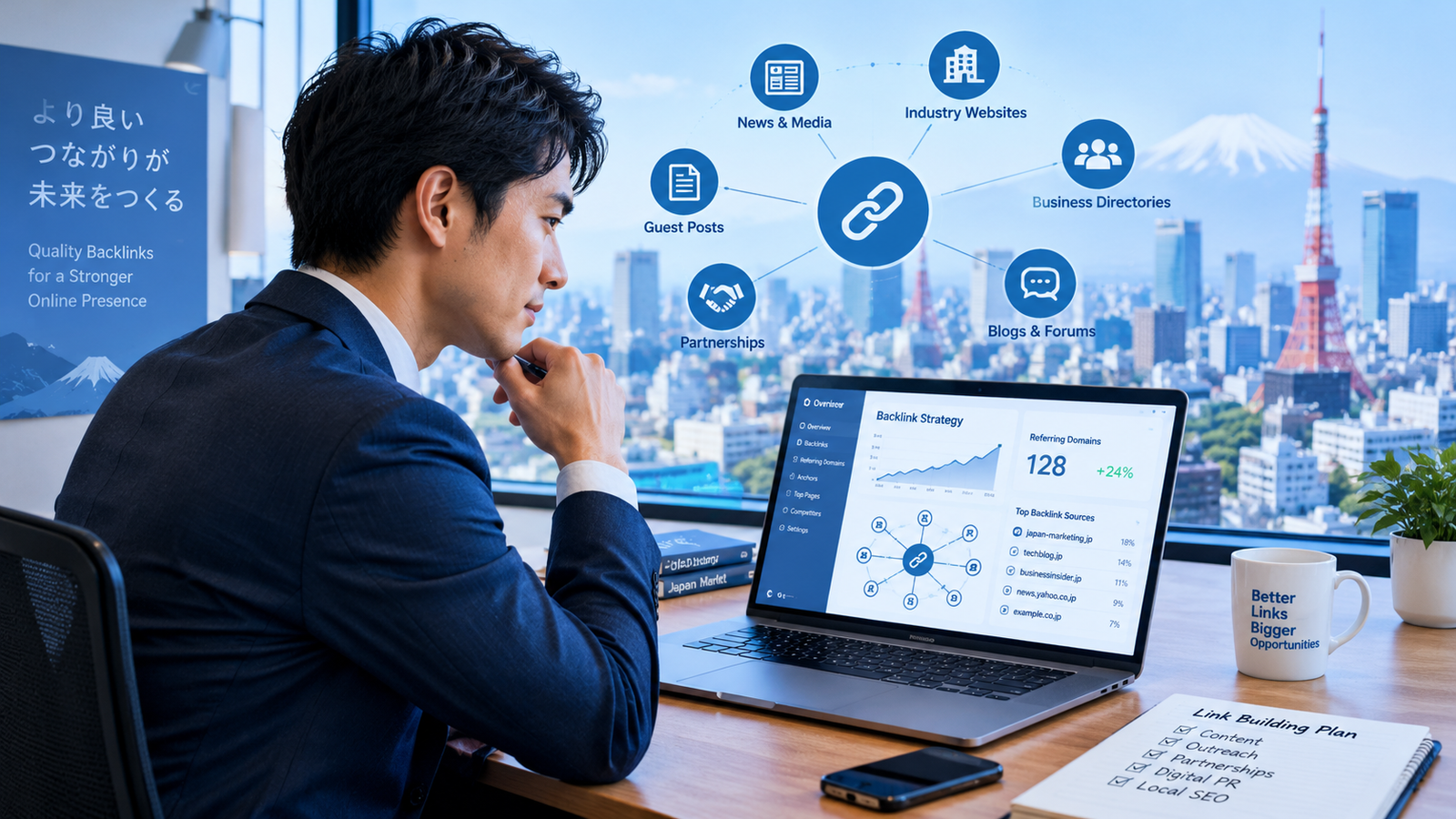
How to Build Quality Backlinks in Japan
- Create Content Japanese Websites Want to Reference
The first step is surprisingly simple:
Create something worth linking to.
Instead of publishing another generic article that repeats information available everywhere, develop content that provides something additional.
Examples include:
- Original research
- Industry statistics
- Detailed guides
- Case studies
- Expert interviews
- Original surveys
- Data-driven articles
- Local market reports
- Comparison guides
- Useful calculators
- Templates
- Infographics
- Research summaries
For example, instead of publishing:
“What Is SEO?”
you could create:
“Japanese SEO Trends: A Practical Guide for International Businesses”
The second topic provides a much stronger reason for industry publications, marketers, and businesses to reference the page.
Google specifically encourages original information, research, analysis, and substantial value rather than simply rewriting existing material.- Localize Your Content for Japanese Audiences
One of the biggest mistakes international businesses make is translating an English article and assuming the job is finished.
Japanese SEO requires more than translation.
Japanese search queries can involve:- Kanji
- Hiragana
- Katakana
- Romaji
- English terms
Search intent can also change depending on how people phrase a query. Current Japanese SEO guidance recommends conducting keyword research specifically for the Japanese market instead of directly translating English keywords.
Example
An English keyword might be:
digital marketing agency
But a Japanese SEO campaign may need to investigate several naturally used Japanese and English variations rather than translating that phrase mechanically.
This is why working with a native Japanese writer, editor, or knowledgeable Japanese SEO professional can make your content much more natural.- Earn Links Through Digital PR
Digital PR can be one of the strongest approaches to earning quality backlinks.
Instead of asking hundreds of websites for links, create something newsworthy.
For example:- Publish original industry research
- Release useful statistics
- Conduct a survey
- Analyze an emerging market trend
- Publish an annual industry report
- Share new business research
- Interview recognized experts
- Create a useful local study
When your research provides genuinely interesting information, journalists and publishers have a reason to reference it.
In Japan, industry publications, news outlets, business media, and PR channels can play an important role in visibility and link acquisition.
The Golden Rule
Don’t create a press release just to manufacture backlinks.
Create something that deserves attention first.- Build Relationships With Japanese Industry Websites
Relationship-based link building can be more sustainable than mass email outreach.
Identify websites related to your industry, such as:- Business publications
- Technology websites
- Marketing blogs
- Startup publications
- Industry associations
- Educational resources
- Professional organizations
- Local business publications
- Specialized communities
Then begin by becoming familiar with their content.
Read their articles.
Understand their audience.
Share useful information.
Contribute meaningful insights.
Eventually, opportunities for collaboration may naturally develop.
Remember:
Relationship first. Link second.
This approach may take longer, but it can produce better-quality opportunities.- Use Guest Contributions Carefully
Guest posting can still be useful when the publication and topic are genuinely relevant.
The problem begins when marketers publish the same low-quality article on dozens of unrelated websites simply to obtain backlinks.
Instead, look for publications where:- Your expertise is relevant
- The audience matches your target customers
- Your contribution adds genuine value
- The website has editorial standards
- The link makes sense in context
For example, a digital marketing company could contribute an article about:
“Local SEO Strategies for Japanese Small Businesses”
to a legitimate marketing publication.
That is much more meaningful than posting an unrelated article on a generic website.- Get Listed in Relevant Japanese Business Directories
Business directories can be useful when they are legitimate, relevant, and maintained.
Potential opportunities may include:- Industry directories
- Professional associations
- Local business listings
- Chamber or trade organizations
- Business resource pages
- Relevant niche directories
But don’t submit your website to hundreds of directories automatically.
Ask:
“Would a real person use this website to find businesses or information?”
If the answer is no, the link may not be worth pursuing.- Work With Japanese Business Associations
If your company operates in Japan or serves Japanese businesses, relevant professional organizations can sometimes provide excellent visibility.
Consider:- Industry associations
- Trade organizations
- Business communities
- Export organizations
- Professional networks
- Local business groups
A genuine association membership or collaboration can potentially lead to:- Company profile links
- Member directory listings
- Interviews
- Event coverage
- Partnership pages
- Resource mentions
The key is to participate for genuine business reasons rather than buying links solely for SEO.- Create Japanese Resource Pages
Resource pages are another opportunity for earning backlinks.
Create comprehensive resources such as:
“Ultimate Japanese SEO Checklist for International Businesses”
or:
“Japan Digital Marketing Resources: Tools, Strategies and Guides”
Make the resource genuinely useful.
Then promote it to:- Marketing professionals
- Business communities
- Universities
- Industry organizations
- Relevant bloggers
- Journalists
- Content creators
If people find the resource genuinely useful, they may reference it naturally.- Use Broken-Link Opportunities
Broken-link building involves finding a relevant page that contains a broken external link and creating a useful replacement resource.
For example:
A Japanese marketing website has an old link about:
“SEO statistics in Japan”
The original resource no longer exists.
You have created a current, well-researched Japanese SEO statistics page.
You can politely notify the website owner and suggest your resource as a possible replacement.
This is not guaranteed to earn a backlink, but it provides a genuine reason for contacting the site owner.- Create Statistics and Original Data
If you want websites to link to you naturally, become a source.
This is one of the most powerful long-term approaches.
For example, publish:
“2026 Japan Small Business Digital Marketing Survey”
Include:- Survey methodology
- Sample size
- Results
- Charts
- Key findings
- Expert commentary
- Downloadable report
Other websites discussing the topic may then reference your research.
One original statistic can sometimes generate multiple mentions.

- Get Featured in Japanese Interviews and Podcasts
- Get Featured in Japanese Interviews and Podcasts
Expert interviews can create excellent brand exposure.
Look for:
- Marketing podcasts
- Business podcasts
- Industry interviews
- YouTube business channels
- Expert roundups
- Online conferences
- Webinars
Don’t approach people with:
“Can you give me a backlink?”
Instead, offer useful expertise.
If your interview is published online, the host may naturally include your company website or profile.
- Use Expert Roundups
Expert roundups bring multiple specialists together around one topic.
For example:
“15 SEO Experts Share Their Best Japanese SEO Tips”
If you contribute a useful, original answer, you may receive brand exposure and potentially a relevant website reference.
But avoid sending generic AI-generated answers.
Give a specific opinion, example, statistic, or practical experience.
- Build Local Backlinks
If your business targets a particular Japanese city, don’t focus only on national websites.
Look for locally relevant opportunities.
For example:
- Local business publications
- City organizations
- Local associations
- Community websites
- Regional news websites
- Local event pages
- Business networks
Local relevance can make a backlink much more meaningful for local SEO campaigns.
- Use Competitor Backlink Analysis
Competitor analysis can help you discover link opportunities.
Study competing websites and ask:
- Who links to them?
- Which publications mention them?
- Which resource pages reference them?
- Which topics attract links?
- Which partnerships do they have?
- Which content generates the most references?
Then identify opportunities that are relevant to your own business.
Important:
Don’t copy your competitor’s backlink profile blindly.
A competitor may have links that are outdated, irrelevant, or low quality.
Use competitor research for opportunity discovery, not duplication.
- Create Link-Worthy Visual Content
Visual content can attract links because publishers often need useful graphics.
Create:
- Infographics
- Charts
- Original diagrams
- Market maps
- Statistics graphics
- Checklists
- Flowcharts
- Industry timelines
For Japan-focused SEO, consider producing graphics containing Japanese-language labels when the target audience is Japanese.

- Create Case Studies
Case studies are naturally linkable because they contain real experiences and results.
For example:
“How a Japanese Small Business Improved Its Organic Visibility: SEO Case Study”
A strong case study can include:
- Starting situation
- Challenges
- Strategy
- Implementation
- Timeline
- Results
- Lessons learned
Avoid making unsupported ranking or traffic claims.
Use verifiable data whenever possible.
- Don’t Ignore Brand Mentions
Sometimes websites mention your:
- Company
- Founder
- Product
- Research
- Report
- Tool
without linking to your website.
These are called unlinked brand mentions.
If the mention is relevant and a link would genuinely help readers, you can politely contact the publisher and ask whether they would consider adding the relevant source.
This is generally a much more natural outreach reason than sending a mass email asking for a backlink.
- Use Social Media for Discovery, Not Just Links
Social media links generally shouldn’t be treated as a replacement for editorial backlinks.
Instead, use social platforms to distribute your content and get it in front of people who may eventually reference it.
For Japan-focused marketing, understand the platforms and communication channels that Japanese audiences actually use.
For example, LINE has a particularly important role in Japan’s digital ecosystem, while search and content remain important acquisition channels.
The objective is:
Content → Exposure → Relationships → Mentions → Natural backlinks
- Use Japanese Anchor Text Naturally
Anchor text is the clickable text used for a link.
Avoid forcing the exact keyword into every backlink.
For example, repeatedly building links with:
“How to Build Quality Backlinks in Japan”
can look unnatural.
A natural backlink profile may contain:
- Brand name
- Website name
- Article title
- Natural phrases
- Descriptive text
- Naked URLs
- Partial keyword phrases
The anchor text should make sense for the reader first.
- Avoid Buying Hundreds of Cheap Backlinks
This is one of the biggest mistakes in link building.
Be suspicious of offers such as:
“500 Japanese backlinks for $20.”
Quantity does not equal quality.
Mass-produced links can come from irrelevant or low-quality websites and may create unnecessary SEO risk.
Google’s guidance emphasizes people-first content and warns against creating content primarily to manipulate search rankings.
Better Strategy
Instead of:
500 random links
aim for:
5–10 highly relevant opportunities
that genuinely connect your brand with the Japanese audience.
A Simple Japan Backlink Strategy for Beginners
If you’re new to Japanese link building, don’t try everything simultaneously.
Follow this simple process.
Step 1: Choose Your Target
Decide:
- Industry
- Japanese audience
- Geographic target
- Main service
- Target keywords
Step 2: Create Link-Worthy Content
Publish:
- Research
- Guides
- Case studies
- Statistics
- Original insights
Step 3: Find Relevant Websites
Build a list of:
- Japanese publications
- Industry blogs
- Associations
- Local websites
- Resource pages
- Podcasts
- Business communities
Step 4: Start Building Relationships
Engage with publishers and industry professionals before asking for anything.
Step 5: Promote Your Best Content
Use:
- Digital PR
- Social media
- Email outreach
- Expert networking
- Industry communities
Step 6: Track Results
Monitor:
- Referring domains
- Referral traffic
- Organic impressions
- Ranking changes
- Brand mentions
- New links
- Conversion activity
Google Search Console can help website owners monitor their performance and search visibility.
Japan Backlink Quality Checklist
Before pursuing a backlink, ask these questions:
|
Question |
Good Sign |
|
Is the website relevant? |
Yes |
|
Does it have a real audience? |
Yes |
|
Is the content useful? |
Yes |
|
Is the website trustworthy? |
Yes |
|
Is the link editorially relevant? |
Yes |
|
Could the link send referral traffic? |
Yes |
|
Is the website overloaded with paid links? |
No |
|
Is the link being created naturally? |
Yes |
|
Would I want this link even without SEO? |
Yes |
That final question is particularly useful:
“Would I still want this link if Google did not exist?”
If the answer is yes, you may have found a genuinely valuable opportunity.
Common Mistakes When Building Backlinks in Japan
Mistake 1: Translating Everything Automatically
Literal translation can produce unnatural Japanese content.
Mistake 2: Chasing .JP Domains Only
A .jp domain does not automatically make a backlink valuable. Relevance and trust matter.
Mistake 3: Buying Cheap Link Packages
Large quantities of low-quality links can create more problems than benefits.
Mistake 4: Using Exact-Match Anchor Text Everywhere
Natural variation is better than forcing one phrase repeatedly.
Mistake 5: Ignoring Content Quality
Backlinks cannot compensate indefinitely for poor content.
Mistake 6: Sending Mass Outreach Emails
Personalized, relevant outreach is generally more useful than sending the same message to hundreds of websites.
Mistake 7: Forgetting Japanese Search Intent
Japanese users may search differently from users in English-speaking markets.
How Many Backlinks Do You Need to Rank in Japan?
There is no universal number.
One website might rank with relatively few strong links, while another may need substantially more because the competition is stronger.
Instead of setting a target such as:
“I need 1,000 backlinks.”
set quality-based goals:
“I want 10 relevant referring domains from credible websites over the next few months.”
Then measure whether those links contribute to:
- Better visibility
- More qualified traffic
- More brand searches
- More leads
- Better topical authority
Remember that backlinks are only one component of SEO.
How Long Does Japanese Link Building Take?
Quality link building is rarely an overnight process.
Some opportunities can happen quickly, while editorial relationships and authority-building may take months.
A practical timeline could look like:
Month 1
Research competitors, publications, keywords, and link opportunities.
Month 2
Publish link-worthy content and begin relationship-based outreach.
Month 3
Launch digital PR, expert outreach, partnerships, and resource-page campaigns.
Month 4+
Continue producing valuable content and building genuine industry relationships.
FOMO Reminder
The businesses that start building authority today may have a significant head start over companies that wait until their competitors dominate the Japanese search results.
Final Thoughts: How to Build Quality Backlinks in Japan
Learning how to build quality backlinks in Japan is not about collecting the largest possible number of links.
It is about creating a network of genuine references around your brand.
The strongest strategy combines:
- Japanese keyword research
- High-quality localized content
- Digital PR
- Original research
- Industry relationships
- Relevant business directories
- Expert interviews
- Resource pages
- Case studies
- Local opportunities
- Strategic outreach
Most importantly, don’t think of backlinks as isolated SEO numbers.
Think of them as digital recommendations.
When a trusted Japanese website references your business because your content, research, product, or expertise genuinely deserves attention, the backlink becomes more than an SEO signal—it becomes a pathway to new audiences, referral traffic, credibility, and potential customers.
Start building your Japanese backlink strategy before your competitors do. The longer you invest in useful content and genuine relationships, the stronger your digital presence can become.