SEO And Google Ads Services: The Ultimate Guide to Growing Your Business Online in 2026
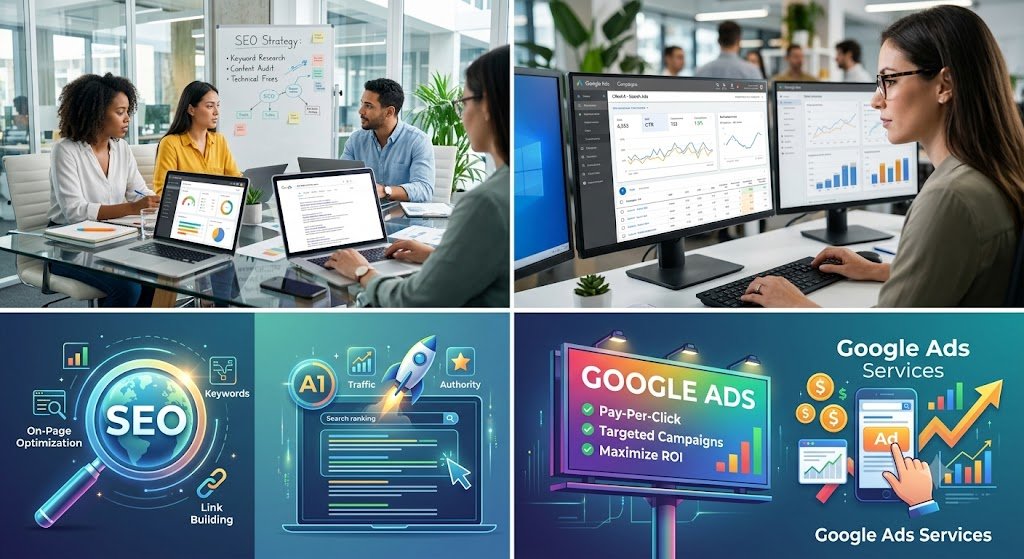
SEO And Google Ads Services: The Complete Guide to Driving More Traffic, Leads, and Sales in 2026
Introduction
If your business isn’t showing up when potential customers search online, you’re losing valuable opportunities every day. Whether you run a local business, an eCommerce store, or a growing company, your audience is already searching for the products or services you offer.
That’s where SEO and Google Ads Services come in.
Search Engine Optimization (SEO) helps your website rank organically on Google, while Google Ads places your business at the top of search results almost instantly. Used together, these two digital marketing strategies create a powerful system that attracts qualified visitors, generates consistent leads, and increases revenue.
In this comprehensive guide, you’ll learn how SEO and Google Ads work, their key differences, their benefits, pricing, and how combining both can help your business outperform competitors in 2026.
The Ultimate Search Monopoly: Why Dominating Both SEO And Google Ads Services Is No Longer Optional In 2026
Let’s be brutally honest for a moment. Right now, your ideal customers are actively typing their biggest problems directly into Google. They are ready to buy, credit card in hand, looking for an immediate solution.
But as they hit search, who do they see? If it isn’t you dominating both the paid ads at the very top and the organic listings right below them, you are handing your market share directly to your competitors on a silver platter.
In the current 2026 digital ecosystem—where AI-driven search overviews and changing user behaviors have transformed the search engine results page (SERP)—relying on just one channel is marketing suicide. If you want to scale rapidly, you must combine SEO And Google Ads Services into a single, unified search engine domination strategy.
Here is exactly how to do it before your competitors beat you to it.
The Cost of Waiting: Why a Siloed Strategy Is Costing You Millions
Most businesses treat search engine optimization (SEO) and pay-per-click (PPC) like distant cousins who don’t get along. The SEO team is over in one corner focused on long-term organic growth, while the PPC team is in another spending ad budget for instant traffic.
This siloed approach leaves a massive gap in your funnel.
The Search Reality: According to recent 2026 search benchmarks, brands that appear in both the top paid ad spots and the top organic results experience an average 60-80% increase in total click-through rates (CTR) and a massive drop in overall customer acquisition costs (CAC).
When you dominate both spaces, you don’t just get more clicks—you achieve Search Monopoly. You take up valuable visual real estate, project massive brand authority, and capture users at every single stage of the buying intent funnel.
Paid Speed vs. Organic Staying Power
To maximize your revenue, you need to understand how these two forces interact. Think of them as the sprint and the marathon of your digital growth engine.
Attribute | Google Ads (PPC) | Search Engine Optimization (SEO) |
Time to Traffic | Instant (Minutes after setup) | Gradual (3 to 6 months) |
Cost Structure | Pay-per-click (Scales with traffic) | Fixed investment (High upfront, zero per-click cost) |
Intent Target | High transactional/commercial intent | Informational, navigational, and transactional |
Stability | Stops the second your budget hits $0 | Continues to drive traffic and leads organically for years |
Primary Value | Rapid testing, instant sales, agility | Long-term equity, compounding ROI, brand authority |
3 Unified Frameworks to Double Your Conversions
When you integrate your SEO And Google Ads Services, 1 + 1 no longer equals 2. It equals 5. Here are three advanced strategies that top-tier digital agencies use to achieve search monopoly.
- The Keyword Cross-Pollination Framework
Stop guessing which keywords will rank organically. Use your Google Ads data as a fast-track testing ground.
- Run highly targeted PPC campaigns on new keywords for 30 days.
- Analyze which exact search terms yield the highest conversion rates and sales—not just clicks.
- Hand those winning, high-converting keywords over to your SEO team to build long-form, high-authority content around them.
This ensures you never waste months of SEO effort ranking for terms that don’t actually generate revenue.
- High-Intent Retargeting
Organic traffic is incredible for building trust, but a large percentage of top-of-funnel blog visitors will leave without converting on their first visit. Don’t let them vanish. Use Google Ads remarketing arrays (including YouTube and the Google Display Network) to serve highly specific, middle-of-funnel offers to users who previously discovered you via organic search.
www.americaneagle.com
- Starving the Competition Out of the SERP
For your most profitable, highest-converting commercial keywords, bid aggressively on Google Ads even if you already rank #1 organically. By occupying the top ad slot, the local map pack, and the first organic position, you effectively push your competitors entirely below the fold on mobile screens. If they can’t be seen, they can’t take your sales.
Tick-Tock: The Window to Dominate Your Industry Is Closing Fast
Every single day you delay integrating your search channels, the cost of entry goes up. In 2026, Google Ads costs-per-click (CPC) are rising annually due to increased competition and automated AI smart bidding systems. Simultaneously, organic search spaces are becoming hyper-selective, favoring businesses that demonstrate true experience, expertise, authoritativeness, and trustworthiness.
If you continue to treat SEO and PPC as separate initiatives, your ad spend will become unsustainably expensive, and your organic visibility will slowly erode. Your competitors are reading this exact same playbook. The brands that claim the top spots this month will establish the data history and authority signals required to lock down those positions for years to come.
Do you want to be the brand setting the pace, or the one struggling to catch up?