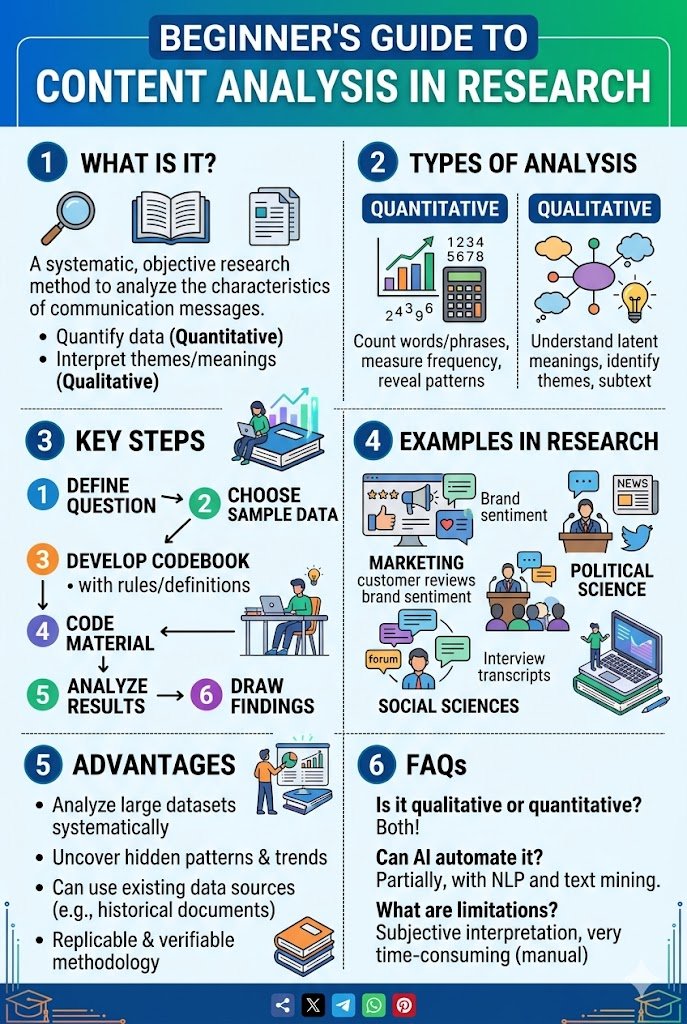
What Is Content Analysis In Research? The Ultimate Beginner’s Guide
Imagine having a mountain of data—thousands of customer reviews, hundreds of interview transcripts, or a year’s worth of competitor social media posts. Hidden inside that mountain are the exact patterns you need to beat your competition, win your market, or ace your study.
But if you don’t know how to mine it, it’s just noise.
That is where content analysis comes in. If you aren’t using this methodology to decode your data, your competitors are already three steps ahead of you, vacuuming up the insights you are missing. Let’s break down exactly what content analysis is, how it works, and how to use it before your data goes stale.
What Is Content Analysis in Research?
Have you ever wondered how researchers analyze thousands of documents, interviews, social media posts, news articles, or survey responses to identify meaningful patterns?
The answer is often Content Analysis.
Content analysis is one of the most widely used research methods for examining and interpreting textual, visual, audio, and digital content. It helps researchers transform large amounts of information into organized, meaningful insights.
Whether you’re a student, academic researcher, marketer, psychologist, journalist, or business analyst, understanding content analysis can significantly improve your research quality.
In this comprehensive guide, you’ll learn everything about content analysis, including its definition, types, examples, process, advantages, limitations, and best practices.
Understanding Content Analysis
Content analysis is a systematic research technique used to analyze communication materials and identify patterns, themes, concepts, meanings, and relationships within data.
Researchers use content analysis to examine:
- Books
- Academic journals
- News articles
- Social media posts
- Videos
- Podcasts
- Advertisements
- Websites
- Survey responses
The primary goal is to convert qualitative information into structured findings that can be interpreted and used for decision-making.
Simple Definition
Content analysis is a research method used to systematically evaluate and interpret the content of communication materials to identify patterns, themes, and meanings.
Why Is Content Analysis Important?
In today’s digital world, massive amounts of information are created every second.
Researchers use content analysis to:
 Discover hidden patterns
Understand public opinions
Analyze customer feedback
Study media coverage
Evaluate communication trends
Improve decision-making
Support academic research
Without content analysis, interpreting large datasets would be extremely difficult and time-consuming.
Types of Content Analysis
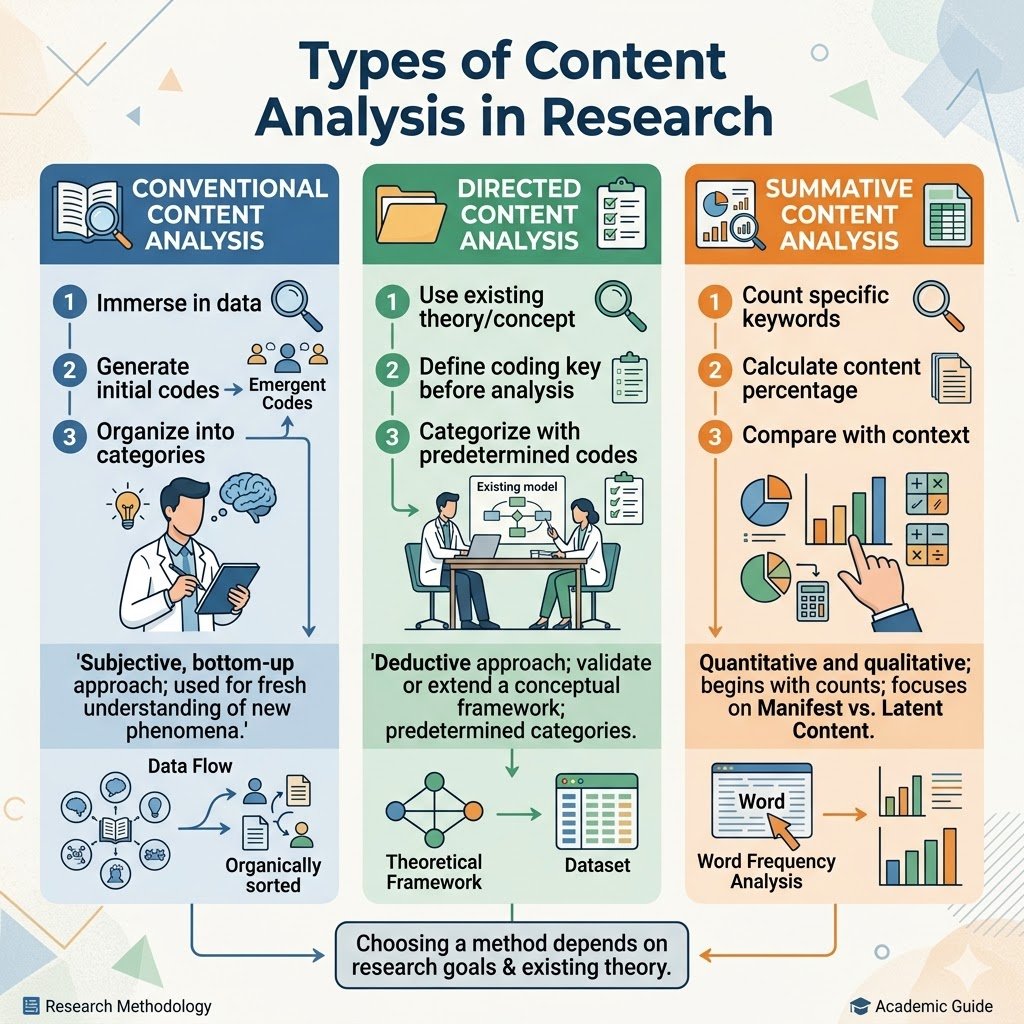
Content analysis generally falls into three major categories.
- Conventional Content Analysis
In this approach, categories emerge directly from the data.
Researchers:
- Read data carefully
- Identify recurring ideas
- Create codes naturally
- Develop themes
Example
A researcher analyzing student feedback discovers recurring themes such as:
- Teaching quality
- Course difficulty
- Classroom environment
These categories were not predetermined.
- Directed Content Analysis
This method begins with an existing theory or framework.
Researchers use predefined categories based on previous studies.
Example
A psychologist studying workplace stress may use established stress indicators such as:
- Anxiety
- Burnout
- Job dissatisfaction
- Summative Content Analysis
This approach focuses on counting and comparing words, phrases, or concepts before interpreting their meaning.
Example
Analyzing political speeches to count how many times terms like:
- Economy
- Employment
- Education
- Healthcare
appear.
- Conventional Content Analysis
- Directed Content Analysis
Quantitative vs Qualitative Content Analysis
Many beginners confuse these two approaches.
|
Feature |
Quantitative Content Analysis |
Qualitative Content Analysis |
|
Focus |
Numbers and frequency |
Meaning and interpretation |
|
Data |
Structured |
Unstructured |
|
Goal |
Measure occurrence |
Understand context |
|
Output |
Statistics |
Themes and insights |
Counting how often a brand name appears in online reviews.
Qualitative Example
Understanding customer emotions expressed in those reviews.
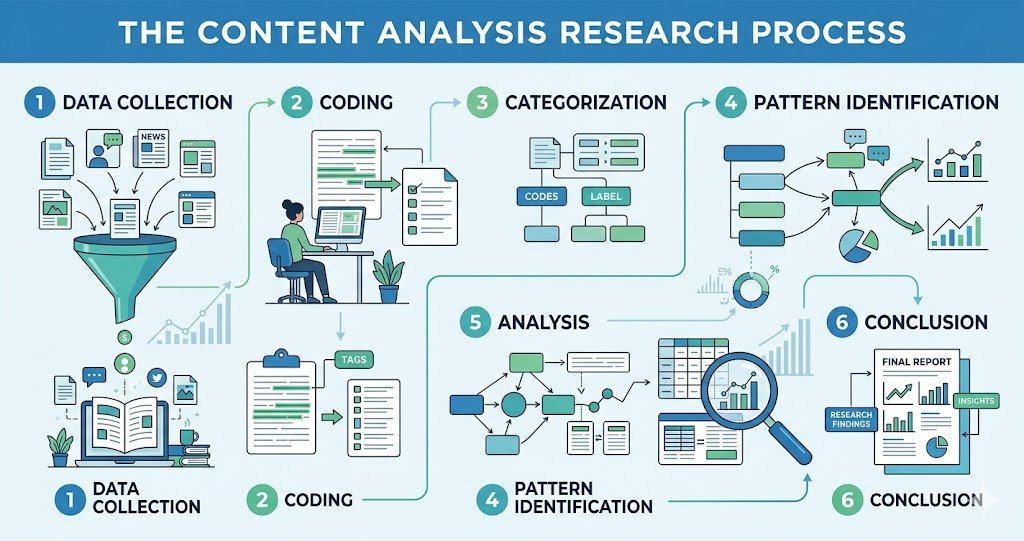
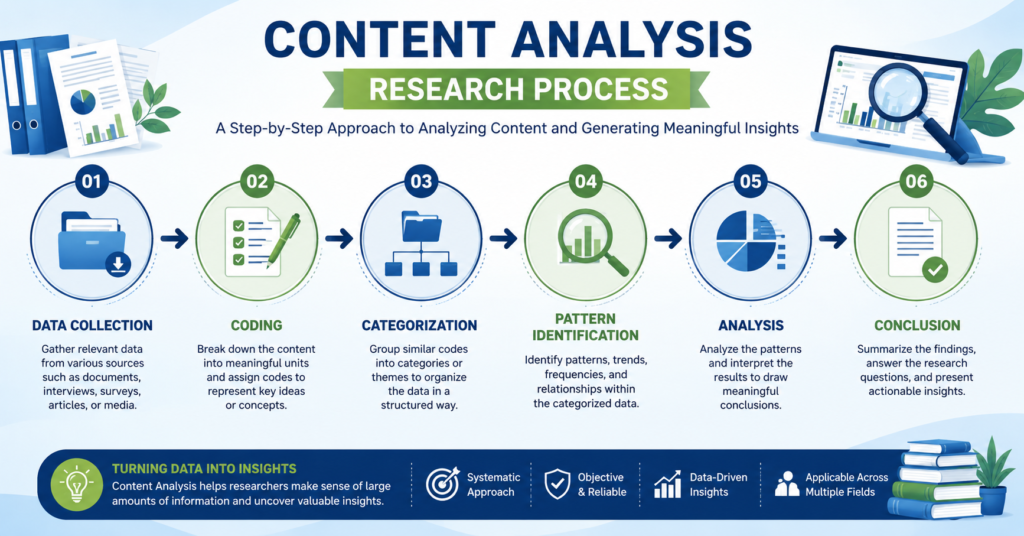
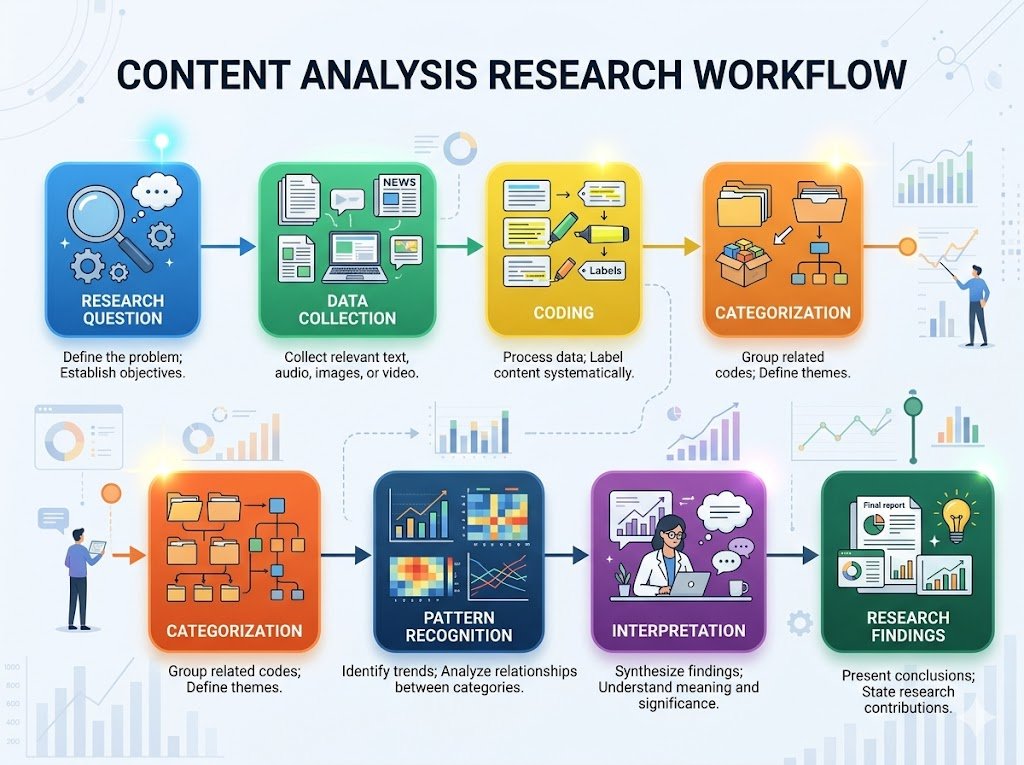
Steps in Content Analysis Research
Following a structured process ensures reliable results.
Step 1: Define Research Question
Start by identifying what you want to investigate.
Example
How do customers perceive eco-friendly products online?
Step 2: Select Content
Choose the data source.
Examples include:
- Customer reviews
- Interview transcripts
- Social media comments
- News reports
Step 3: Develop Coding Categories
Create categories or themes.
Examples:- Positive sentiment
- Negative sentiment
- Product quality
- Price concerns
Step 4: Code the Data
Assign labels to relevant pieces of information.
Example
Comment:
“This product is environmentally friendly and affordable.”
Codes:- Sustainability
- Affordability
Step 5: Analyze Patterns
Look for recurring themes and trends.
Questions to ask:
- Which themes occur most frequently?
- What relationships exist?
- What insights emerge?
Step 6: Interpret Results
Explain what the findings mean in relation to the research objectives.
Real-World Examples of Content Analysis
Example 1: Social Media Research
Researchers analyze Twitter posts to understand public reactions to a new policy.
Example 2: Marketing Research
Businesses study customer reviews to improve products.
Example 3: Media Studies
Researchers examine newspaper coverage of climate change.
Example 4: Education Research
Universities analyze student feedback to improve teaching methods.
Advantages of Content Analysis
Researchers love content analysis because it offers numerous benefits.
- Cost-Effective
Many data sources are already available.
- Non-Intrusive
Researchers can analyze content without influencing participants.
- Flexible
Applicable to text, images, audio, and video.
- Large Data Handling
Can process vast amounts of information efficiently.
- Historical Research
Useful for analyzing archived documents and records.
Limitations of Content Analysis
Like any research method, content analysis has challenges.
Subjectivity
Different researchers may interpret data differently.
Context Loss
Important meanings can sometimes be overlooked.
Time-Consuming
Coding large datasets requires significant effort.
Data Quality Issues
Poor-quality content can affect accuracy.
Best Practices for Effective Content Analysis
To improve reliability:
Use Clear Coding Rules
Ensure consistency.
Define Categories Carefully
Avoid overlapping themes.
Train Multiple Coders
Increase reliability.
Use Software Tools
Popular tools include:
- NVivo
- MAXQDA
- Atlas.ti
- Dedoose
Document Every Step
Maintain transparency.
Common Applications of Content Analysis
Content analysis is used across many fields.
Academic Research
Studying literature and scholarly content.
Business Research
Analyzing customer opinions and feedback.
Digital Marketing
Evaluating social media engagement.
Healthcare Research
Examining patient experiences.
Political Science
Analyzing speeches and campaign messages.
Journalism
Studying media trends and news framing.
Content Analysis vs Thematic Analysis
Many students confuse these methods.
|
Feature |
Content Analysis |
Thematic Analysis |
|
Focus |
Frequency and meaning |
Themes and experiences |
|
Structure |
More systematic |
More flexible |
|
Quantification |
Often included |
Rarely included |
|
Use Case |
Large datasets |
In-depth understanding |
Future of Content Analysis
Artificial intelligence is transforming content analysis.
Modern tools can now:
- Analyze millions of documents
- Detect sentiment automatically
- Identify emerging trends
- Generate predictive insights
As AI advances, content analysis will become faster, more accurate, and more valuable across industries.
Frequently Asked Questions (FAQs)
What is content analysis in simple words?
Content analysis is a research method used to study text, images, audio, or other communication materials to identify patterns, themes, and meanings.
Is content analysis qualitative or quantitative?
It can be both. Researchers may focus on numerical counts (quantitative) or meanings and interpretations (qualitative).
What are the three types of content analysis?
The three major types are:
- Conventional Content Analysis
- Directed Content Analysis
- Summative Content Analysis
What is an example of content analysis?
Analyzing customer reviews to identify common complaints and positive experiences is a common example.
Why is content analysis important?
It helps researchers organize large amounts of information and uncover valuable insights that support decision-making.
Which software is used for content analysis?
Popular tools include:
- NVivo
- MAXQDA
- Atlas.ti
- Dedoose