What Is A Marketing Funnel? The Complete Beginner's Guide to Turning Visitors into Customers
Have you ever wondered why thousands of people visit a website, but only a few actually buy something?
The answer lies in a powerful marketing concept known as the Marketing Funnel.
A marketing funnel helps businesses guide potential customers through a journey—from discovering a brand to making a purchase and becoming loyal customers.
In today’s competitive digital world, companies that understand and optimize their marketing funnels often generate significantly more leads, sales, and revenue than those that don’t.
If you’re not using a marketing funnel yet, you could be losing valuable customers every day.
Let’s dive in.
What Is a Marketing Funnel?
A marketing funnel is a structured, stage-by-stage framework that maps out a prospect’s complete journey from the exact moment they discover your brand to the moment they make a purchase (Jampur et al.).
It takes its shape from a physical funnel: wide at the top (where thousands of curious onlookers enter) and narrow at the bottom (where highly qualified buyers exit).
Historically, marketing funnels were managed using simple rule-based heuristics and surveys (Bertozzi et al., 2022). Today, they operate as dynamic, data-driven pipelines.
Modern systems leverage automated conversion tracking and edge-computed analytics to serve tailored content in real-time, drastically reducing user drop-off during the buying cycle (Karthick, 2026).
The Three Core Pillars of the Funnel
To effectively convert anonymous traffic into brand advocates, your marketing strategy must segment the consumer journey into three distinct phases.
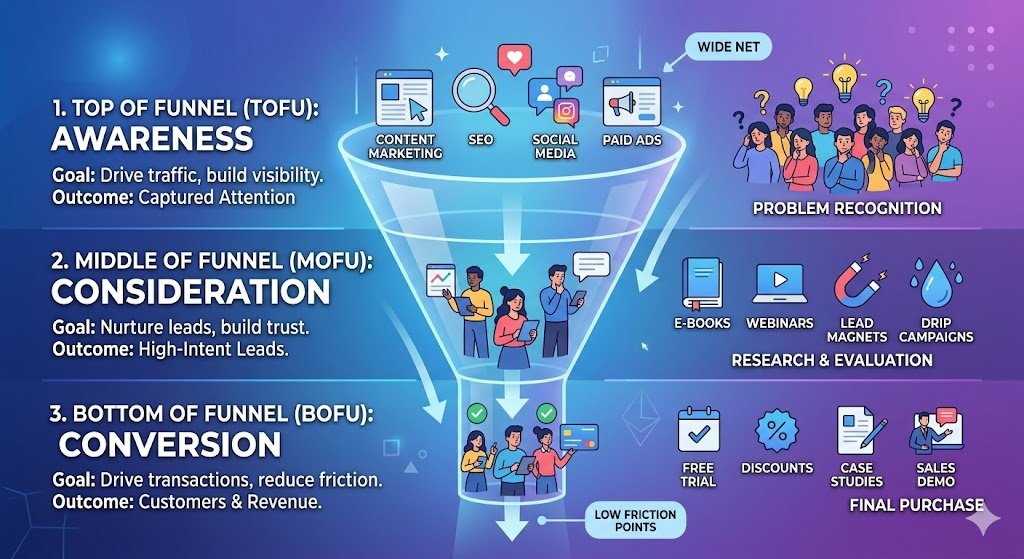
\ Top of Funnel (TOFU) – Awareness / \ / \ Middle of Funnel (MOFU) – Choice / \ / \ Bottom of Funnel (BOFU) – Buy /
1. Top of Funnel (TOFU): The Awareness Stage
- The Goal: Cast a wide net to capture attention, build visibility, and generate raw traffic.
- The Blueprint: At this initial point, consumers are facing an informational need or a specific problem, but they don’t know your business exists (Nilsson Vestola). You attract them via Search Engine Optimization (SEO), high-value educational blog posts, social media outreach, and broad digital advertising (Karthick, 2026; Jampur et al.).
- The Reality Check: Do not try to sell here. Focus on delivering value to overcome content saturation and capture initial interest (Nilsson Vestola).
2. Middle of Funnel (MOFU): The Consideration Stage
- The Goal: Build deep trust, demonstrate authority, and qualify interested leads.
- The Blueprint: Once a user moves into the middle phase, they have self-identified their problem and are actively evaluating potential options (Jampur et al.). At this point, the attrition risk spikes significantly; research indicates that the transition from initial interest to consideration sees the steepest drop-off in the entire pipeline (Jampur et al.).
- The Fix: Nurture these prospects by exchanging deep-dive resources—like e-books, case studies, webinars, or product demonstrations—for their contact details (Karthick, 2026).
3. Bottom of Funnel (BOFU): The Conversion Stage
- The Goal: Eliminate friction, leverage urgency, and finalize the commercial transaction.
- The Blueprint: This is the narrowest point of the architecture. The prospect is ready to purchase but needs a final nudge to choose you over a direct competitor. High-intent triggers work best here: exclusive discounts, free trials, comparison sheets, and personalized outreach (Jampur et al.).
- The Clock is Ticking: Milliseconds matter here. Slow page loads or confusing checkouts during critical checkout moments can erode conversion rates by up to 40% (Karthick, 2026).
Marketing Funnel Definition
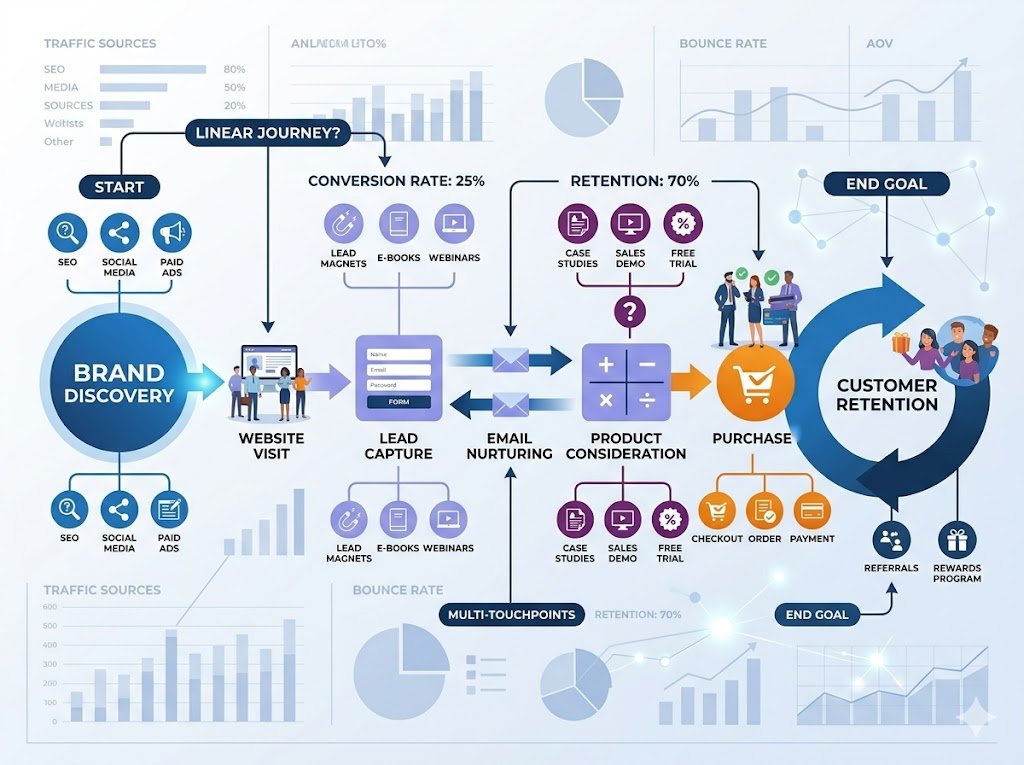
A marketing funnel is a visual representation of the customer journey from the first interaction with a brand until they become a paying customer and, ideally, a repeat buyer.
It is called a funnel because:
- Many people enter at the top.
- Fewer continue to the middle.
- Only a portion reaches the bottom and converts.
The funnel helps marketers understand customer behavior and improve conversion rates at every stage.
Why Is a Marketing Funnel Important?
Without a structured funnel, businesses often:
 Waste advertising budgets
Lose qualified leads
Experience low conversion rates
Struggle to scale revenue
A well-designed marketing funnel helps businesses:
 Generate quality leads
Increase conversions
Improve customer relationships
Reduce marketing costs
Grow predictable revenue
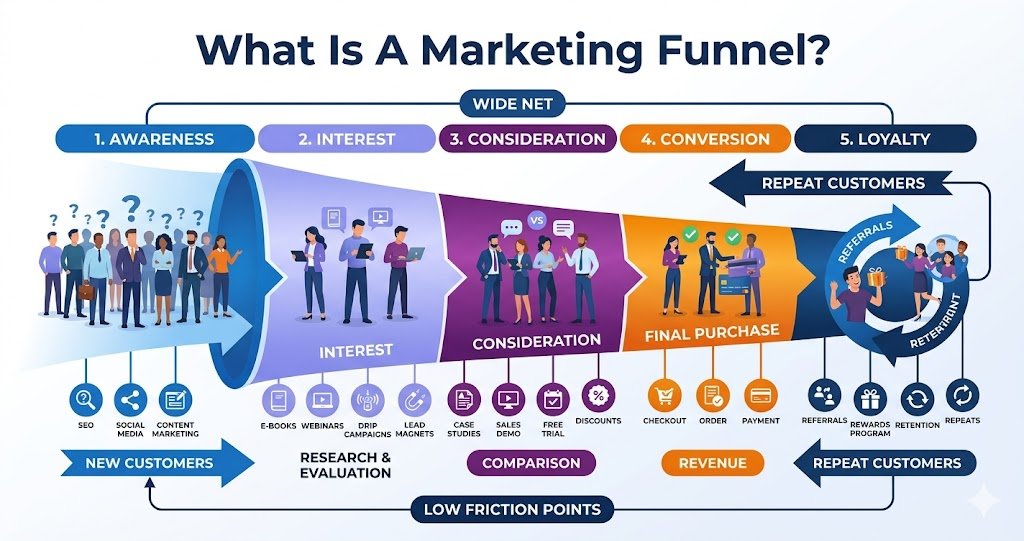
The 5 Stages of a Marketing Funnel
Understanding each stage is essential for maximizing results.
- Awareness Stage
This is where potential customers discover your business for the first time.
Common awareness channels include:
- SEO
- Google Search
- Social Media
- YouTube
- Blog Articles
- Paid Advertising
- Influencer Marketing
Goal
Get attention and create brand awareness.
Example
Someone searches:
“Best Digital Marketing Agency”
Your website appears in search results.
- Interest Stage
After discovering your brand, users begin learning more about your products or services.
At this stage they may:
- Read blog posts
- Watch videos
- Follow social media accounts
- Subscribe to newsletters
Goal
Build trust and educate prospects.
- Consideration Stage
Now prospects are evaluating options.
They compare:- Features
- Pricing
- Reviews
- Competitors
- Testimonials
Goal
Show why your solution is the best choice.
Effective content includes:
- Case Studies
- Product Comparisons
- Testimonials
- Webinars
- Free Trials
- Conversion Stage
This is where prospects become customers.
Examples include:
- Purchasing a product
- Booking a consultation
- Requesting a quote
- Signing up for a service
Goal
Remove friction and encourage action.
Optimization strategies:
- Clear CTAs
- Fast-loading pages
- Simplified checkout process
- Trust badges
- Money-back guarantees
- Loyalty and Advocacy Stage
- Consideration Stage
The funnel doesn’t end after a sale.
Satisfied customers can become:
- Repeat buyers
- Brand advocates
- Referral sources
Goal
Increase customer lifetime value.Strategies include:
- Loyalty programs
- Email marketing
- Exclusive offers
- Referral rewards
- VIP memberships
A Real-Life Marketing Funnel Example
Imagine you own an online fitness coaching business.
Awareness
A user finds your fitness blog through Google.
Interest
They download a free workout guide.
Consideration
They attend your webinar.
Conversion
They purchase your coaching package.
Loyalty
They renew their membership and refer friends.
That’s a marketing funnel in action.
Types of Marketing Funnels
Lead Generation Funnel
Designed to collect leads through:
- E-books
- Webinars
- Free tools
- Checklists
Sales Funnel
Focused on converting prospects into paying customers.
Email Marketing Funnel
Uses automated emails to nurture leads and increase conversions.
Webinar Funnel
Uses educational webinars to build trust and drive sales.
E-commerce Funnel
Designed specifically for online stores.
Stages often include
- Product Discovery
- Product View
- Add to Cart
- Checkout
- Purchase
How to Build an Effective Marketing Funnel
Step 1: Understand Your Audience
Research:
- Pain points
- Goals
- Demographics
- Search intent
Step 2: Create Awareness Content
Publish:
- Blog posts
- Videos
- Infographics
- Social media content
Step 3: Capture Leads
Offer valuable lead magnets:
- Free PDFs
- Templates
- Courses
- Consultations
Step 4: Nurture Prospects
Use:
- Email sequences
- Retargeting ads
- Educational content
Step 5: Optimize Conversions
Improve:
- Landing pages
- Calls-to-action
- User experience
Step 6: Retain Customers
Focus on:
- Customer service
- Loyalty programs
- Personalized offers
Common Marketing Funnel Mistakes
Many businesses lose sales because they
Ignoring Lead Nurturing
Not every visitor buys immediately.
Weak Calls-To-Action
Users need clear next steps.
Poor Landing Pages
Slow or confusing pages reduce conversions.
Lack of Follow-Up
Email automation can recover lost opportunities.
No Funnel Tracking
Measure performance regularly.
Marketing Funnel Metrics to Track
Monitor:
- Website Traffic
- Click-Through Rate (CTR)
- Lead Conversion Rate
- Cost Per Lead (CPL)
- Customer Acquisition Cost (CAC)
- Return On Investment (ROI)
- Customer Lifetime Value (CLV)
These metrics reveal where prospects are dropping out.
 Companies that fail to optimize their marketing funnels risk losing customers to competitors who provide a smoother buying experience.