What Is Robotic Process Automation (RPA)? A Complete Beginner's Guide for 2026
What Is Robotic Process Automation Neha P Verma
 

Introduction


That’s exactly what Robotic Process Automation (RPA) offers.
Imagine if your business could complete repetitive tasks 24/7 without making mistakes, taking breaks, or needing supervision. Sounds incredible, right?


As companies continue embracing digital transformation, RPA has become one of the fastest-growing technologies worldwide. Businesses of all sizes are using it to automate routine tasks, reduce costs, improve efficiency, and free employees to focus on higher-value work.
🚀 The biggest question is:


If your competitors are already automating their operations, can your business afford to wait?


In this comprehensive guide, you’ll learn everything about Robotic Process Automation, how it works, its benefits, use cases, challenges, and why it’s becoming essential in 2026 and beyond.
What Is Robotic Process Automation Neha P verma

What Is Robotic Process Automation (RPA)?


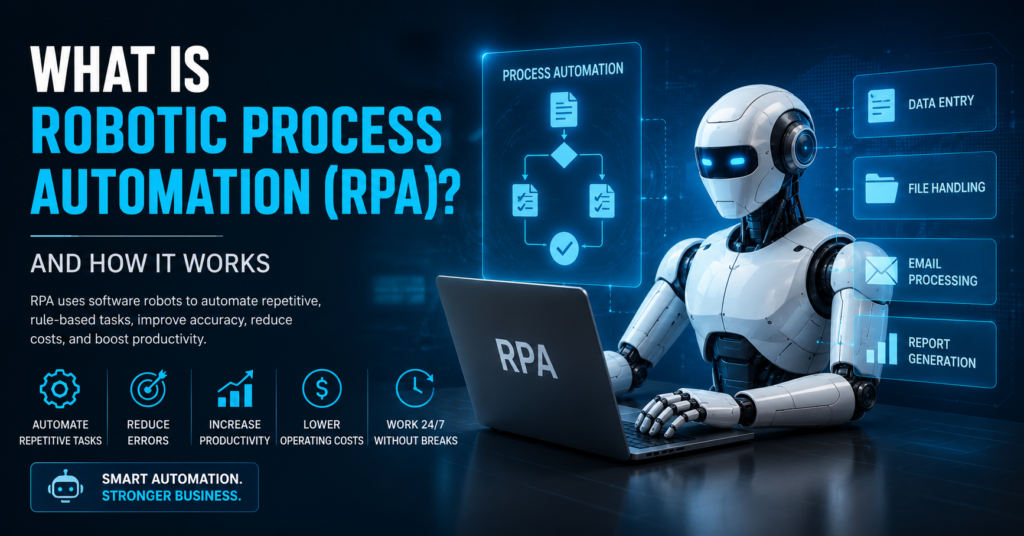
Robotic Process Automation (RPA) is a technology that uses software robots (bots) to automate repetitive, rule-based tasks that humans typically perform on computers.

These bots can:

  • Enter data
  • Extract information
  • Generate reports
  • Move files between systems
Unlike physical robots, RPA bots operate in digital environments and mimic human interactions with software applications.

Simple Example


Suppose an employee spends 4 hours daily copying information from emails into spreadsheets.

An RPA bot can:

✅ Read emails automatically
✅ Extract relevant data
✅ Update spreadsheets
✅ Send confirmation emails
✅ Complete the task in minutes
Without human intervention.
Why Is RPA Becoming So Popular?


Businesses face increasing pressure to:


  • Reduce operational costs
  • Improve accuracy
  • Deliver faster customer service
  • Scale operations efficiently

RPA helps achieve all these goals simultaneously.

Key Statistics

Organizations implementing RPA often experience:

  • Faster task completion
  • Reduced human errors
  • Improved productivity
  • Better customer satisfaction
  • Significant cost savings

This is why industries worldwide are investing heavily in automation technologies.

How Does Robotic Process Automation Work?

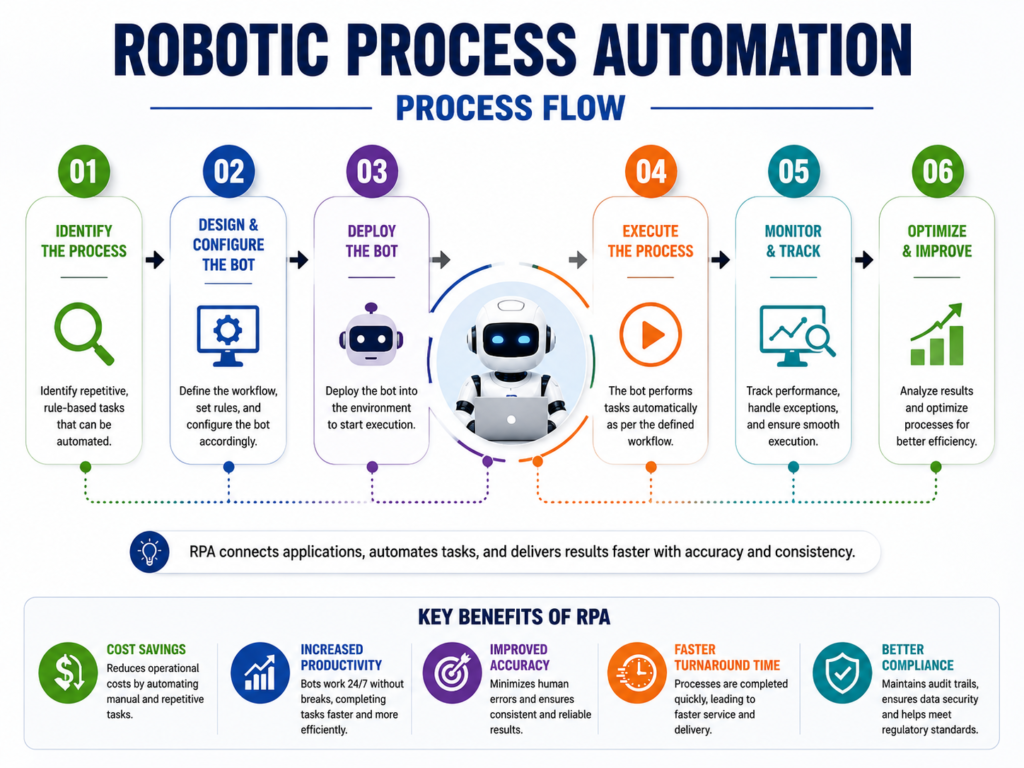
RPA bots follow predefined rules and workflows.

The process generally involves:

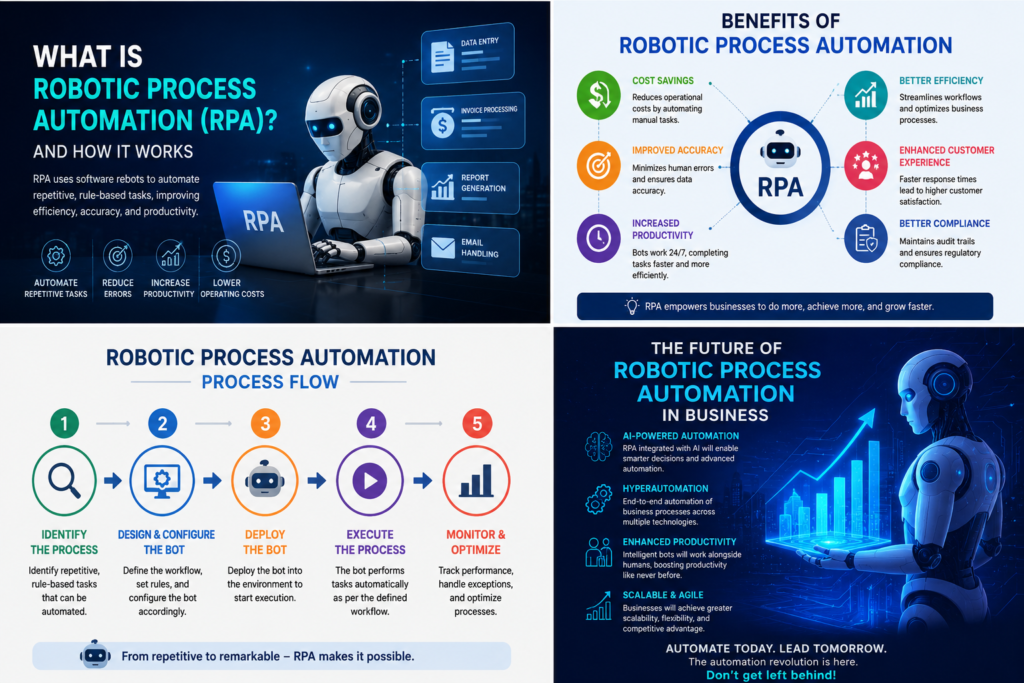
Step 1: Identify Repetitive Tasks


Businesses identify tasks that:

  • Follow fixed rules
  • Require minimal decision-making
  • Are performed frequently

Step 2: Configure the Bot


Developers or automation specialists define:

  • Inputs
  • Actions
  • Conditions
  • Outputs

Step 3: Execute Automation


The bot performs tasks automatically by interacting with applications just like a human user.

Step 4: Monitor and Optimize


Performance is tracked and workflows are improved over time.

What Is Robotic Process Automation Neha P Verma

Types of Robotic Process Automation

  1. Attended RPA
Works alongside employees.
Example:
A customer support agent receives assistance from a bot during live interactions.

Benefits

  • Faster service
  • Improved employee productivity
  • Reduced workload
  1. Unattended RPA
Runs independently without human intervention.

Example:

Processing invoices overnight automatically.
Benefits

  • 24/7 automation
  • High scalability
  • Increased efficiency
  1. Hybrid RPA
Combines attended and unattended automation.

Benefits

  • Maximum flexibility
  • Improved workflow management
Better business outcomes

Benefits of Robotic Process Automation


  1. Significant Cost Reduction
Automation reduces manual labor costs and operational expenses.
Businesses often save thousands annually through automated workflows.

  1. Improved Accuracy
Humans make mistakes.
Bots follow rules consistently.

Result:

✔ Fewer errors
✔ Better compliance
✔ Improved data quality
  1. Increased Productivity

Bots can work:


  • 24/7
  • Without breaks
  • At high speed
This dramatically increases output.

  1. Enhanced Customer Experience

Faster processing means:

  • Quicker responses
  • Improved service quality
  • Higher customer satisfaction
  1. Better Compliance
RPA maintains detailed logs and audit trails.

This helps organizations meet regulatory requirements.
What Is Robotic Process Automation Neha P Verma
Full Name
Name

Real-World Applications of RPA

Banking and Finance

Automation is used for:


  • Loan processing
  • Account opening
  • Fraud detection
  • KYC verification

Healthcare

Healthcare providers automate:

  • Patient registration
  • Claims processing
  • Appointment scheduling
  • Medical record updates

Human Resources

HR teams automate:

  • Employee onboarding
  • Payroll management
  • Attendance tracking
  • Recruitment workflows

E-commerce

Online businesses use RPA for:

  • Inventory updates
  • Order processing
  • Customer support
  • Shipment tracking

Accounting

Finance departments automate:

  • Invoice processing
  • Tax calculations
  • Financial reporting
  • Data reconciliation
 

Industries That Benefit Most From RPA


Banking


High-volume transactions and compliance requirements make automation essential.

Insurance

Claims processing becomes faster and more accurate.

Manufacturing

Supply chain management improves significantly.

Telecommunications

Customer service automation boosts efficiency.

Retail

Order fulfillment and inventory management become streamlined.

Challenges of Robotic Process Automation

While RPA offers many benefits, it isn’t perfect.

Initial Setup Costs

Implementation requires investment in:
  • Software
  • Training
  • Integration

RPA vs Artificial Intelligence (AI)

Many people confuse RPA and AI.

Here’s the difference:

RPA

AI

Rule-based

Learns from data

Repetitive tasks

Complex decisions

Structured data

Structured & unstructured data

Mimics actions

Mimics intelligence

Best Results?
Combine RPA and AI together.
This creates Intelligent Automation.

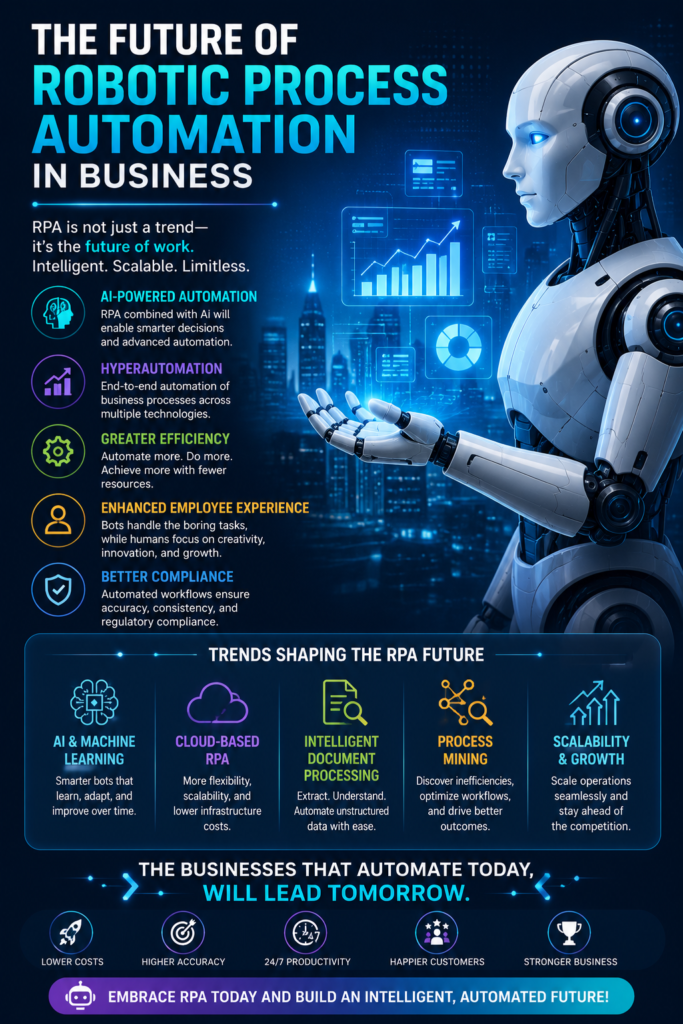
Future of Robotic Process Automation

The future looks extremely promising.

Emerging trends include:

  • AI-powered automation
  • Hyperautomation
  • Intelligent document processing
  • Process mining
  • Predictive analytics
Experts predict automation adoption will continue accelerating across all industries.
⚡ Businesses that delay automation risk falling behind more agile competitors.

Why Businesses Should Adopt RPA Now

Every day spent on manual processes means:

❌ Lost productivity

❌ Higher costs

❌ Increased errors

❌ Slower customer service

Meanwhile, competitors are leveraging automation to gain a significant advantage.

The sooner organizations adopt RPA, the sooner they unlock efficiency, scalability, and growth opportunities.

Frequently Asked Questions (FAQs)


What is Robotic Process Automation in simple words?


RPA is software technology that uses digital bots to automate repetitive computer tasks that humans normally perform.

Is RPA the same as Artificial Intelligence?


No.
RPA follows predefined rules, while AI learns from data and makes decisions.

Which industries use RPA?

Industries including banking, healthcare, insurance, retail, manufacturing, telecommunications, and finance widely use RPA.

Does RPA require coding?

Not always.

Many modern RPA platforms offer low-code or no-code interfaces.

Is RPA suitable for small businesses?

Yes.
Small businesses can automate repetitive tasks to save time, reduce costs, and improve efficiency.

What are popular RPA tools?

Popular RPA platforms include:

  • UiPath
  • Automation Anywhere
  • Blue Prism
  • Microsoft Power Automate

WorkFusion

Conclusion

Robotic Process Automation is transforming how businesses operate by automating repetitive tasks, improving efficiency, reducing costs, and increasing accuracy.

Whether you’re a startup, small business, or large enterprise, RPA can help streamline operations and create a competitive advantage in today’s digital economy.

🚀 The automation revolution is already underway.

Organizations that embrace RPA today will be better positioned for growth, innovation, and long-term success in the years ahead.
Scroll to Top