What is Prompt Engineering in AI? (And Why You Are Falling Behind Without It)

what is prompt engineering in ai Neha P Verma
If you are still typing “write a blog post about digital marketing” into ChatGPT and expecting top-tier, Google-ranking content, you are already losing to your competitors.


The digital landscape is experiencing a seismic shift. AI isn’t going to replace content creators, SEO specialists, or ad managers. However, professionals who know how to control AI will absolutely replace those who don’t.

The secret to unlocking that control? Prompt Engineering.

If you don’t master this skill now, you risk becoming obsolete in a market that values precision and scale. Here is everything you need to know to turn AI from a basic writing assistant into your most powerful strategic asset.

 what prompt engineering in AI is and why it's the most critical skill for 2026. Learn to write better prompts and outpace the competition today.
What Is Prompt Engineering in AI? Complete Beginner's Guide

Artificial Intelligence (AI) has transformed how people work, learn, create content, and solve problems. One of the most important skills emerging in the AI era is Prompt Engineering.

Whether you’re using AI tools for content creation, coding, digital marketing, customer support, or business automation, understanding prompt engineering can dramatically improve your results.

In this comprehensive guide, you’ll learn:

✔ What prompt engineering is
✔ Why prompt engineering matters
✔ How prompts influence AI outputs
✔ Types of prompts
✔ Prompt engineering techniques
✔ Career opportunities
✔ Best practices and common mistakes
Let’s dive in.

What Exactly is Prompt Engineering?

At its core, prompt engineering is the practice of designing, refining, and optimizing the instructions (prompts) you feed into generative AI models to get the exact output you want.

Think of an AI model like a brilliant, encyclopedic intern who lacks common sense. If you give this intern a vague instruction (“Write a Facebook ad”), they will give you a generic, boring result. But if you give them a hyper-specific brief—including the target audience, tone of voice, character limits, and the exact call-to-action—they will deliver a masterpiece.

Prompt engineering is the science of writing that perfect brief.

The Core Elements of a Winning Prompt

To get top 1% outputs, a prompt must contain specific parameters:

  1. Role/Persona: Who is the AI supposed to be? (e.g., “Act as a Senior SEO Strategist…”)

  2. Task: What exactly do you want it to do? (e.g., “…write a 1,500-word article on…”)

  3. Context: What is the background information? (e.g., “…targeting small business owners in Delhi who want to run local Facebook Ads.”)

  4. Format/Constraints: How should it look? (e.g., “…use markdown, keep paragraphs under 3 sentences, and ensure the intro is exactly 100 words.”)

How Prompt Engineering Works.


AI models analyze your prompt and predict the most relevant response based on patterns learned during training.

The process looks like this:

  1. User enters a prompt.
  2. AI interprets the instructions.
  3. AI generates a response.
  4. User refines the prompt if needed.
  5. Output improves through iteration.

Think of AI as a highly skilled assistant.

The clearer your instructions, the better the results.

Why is Prompt Engineering the Ultimate Career Cheat Code?
what is prompt engineering in ai Neha P Verma
Understanding what prompt engineering is in AI is just the first step; applying it is where the ROI lives. Here is why adopting this skill is non-negotiable:

  • 10x Content Velocity: Stop staring at a blank page. A well-engineered prompt can generate highly rankable outlines, draft long-form content, and create perfectly sized meta descriptions in seconds, allowing you to scale your output without sacrificing quality.
  • Eliminates “AI Hallucinations”: Vague inputs lead to made-up facts. Strict, engineered constraints force the AI to stay grounded in the data you provide.
  • Unlocks True Personalization: You can engineer prompts to analyze massive datasets or audience personas, allowing you to generate hyper-targeted ad copy that speaks directly to a customer’s pain points.

Good Prompt vs. Bad Prompt: A Real-World Example

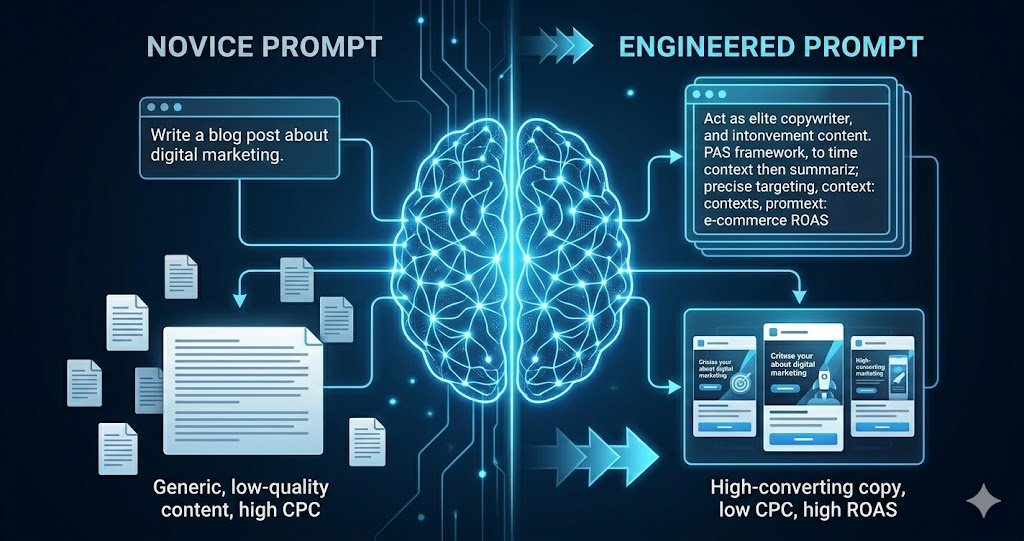
Let’s look at the difference between a beginner and a prompt engineer when trying to generate ad copy for a Google Shopping Ads agency.

❌ The Bad Prompt (The Beginner Approach):

“Write an ad for my Google Shopping agency.”

The Result:
A generic, boring ad that sounds like a robot wrote it. It will blend in, and your Cost-Per-Click (CPC) will skyrocket because nobody will click it.

✅ The Engineered Prompt (The Expert Approach):

“Act as an elite direct-response copywriter. Write three variations of Google Search Ad copy for a B2B digital marketing agency specializing in Google Shopping Ads.
The target audience is e-commerce store owners struggling with high ad spend and low ROAS.
Use the PAS (Problem, Agitation, Solution) framework.

Keep headlines under 30 characters and descriptions under 90 characters. Focus on the emotional relief of finally getting a positive ROI.”

The Result:
High-converting, psychologically driven ad copy that fits perfectly within Google’s character limits and speaks directly to the client’s wallet.

Components of an Effective Prompt

A powerful prompt generally includes:

1. Role Assignment

Tell the AI who it should act as.

Example:

Act as a certified digital marketing consultant.

2. Task Definition

Clearly define what you want.

Example:

Create an SEO-friendly blog post.

3. Context
Provide relevant background information.


Example:

The target audience is small business owners.

4. Output Format


Specify the desired structure.

Example:

Include H2 headings, bullet points, FAQs, and conclusion.

5. Constraints

Set limitations if necessary.

Example:

Keep the article under 2,000 words.

Types of Prompt Engineering

Zero-Shot Prompting

The AI receives a task without examples.


Example:

Explain blockchain technology.

One-Shot Prompting

The AI receives one example.

Example:

Example: Social media increases brand awareness. Now explain how email marketing benefits businesses.

Few-Shot Prompting

Multiple examples guide the AI.

This often improves accuracy.

Chain-of-Thought Prompting

Encourages step-by-step reasoning.

Example:

Explain your reasoning step by step before giving the final answer.

Best Prompt Engineering Techniques

Be Specific

Avoid vague instructions.

Instead of:

Write about SEO.

Use:

Write a beginner-friendly guide about local SEO for small businesses.

Define the Audience

Example:

Explain cloud computing to a 12-year-old student.

Specify Tone

Example:

Write in a professional yet conversational tone.

Use Structured Instructions

Example:

Include introduction, benefits, examples, FAQs, and conclusion.

Request Examples
Example:

Provide five real-world examples.

Prompt Engineering Examples
Example 1: Content Writing

Prompt:

Write a 1,500-word SEO article on social media marketing for businesses.
Result:

Well-structured, search-engine-friendly content.

Example 2: Coding

Prompt:

Create a Python script that calculates compound interest.

Result:

Functional code with explanations.

Example 3: Customer Support
Prompt:


Respond professionally to a customer requesting a refund.

Result:

Polished customer service response.

Prompt Engineering in Digital Marketing

Prompt engineering has become a powerful tool for marketers.

Applications include:

  • Blog writing
  • SEO optimization
  • Keyword research
  • Ad copy creation
  • Email marketing
  • Social media content
  • Landing page development
  • Customer engagement
Digital marketers who master prompt engineering can produce high-quality content much faster than traditional methods.

Industries Using Prompt Engineering

Many industries now rely on prompt engineering:

  • Healthcare
  • Education
  • Finance
  • Marketing
  • E-commerce
  • Software Development
  • Customer Service
  • Human Resources
  • Real Estate
The demand continues to grow as AI adoption increases worldwide.

Career Opportunities in Prompt Engineering

Prompt engineering has emerged as a valuable career skill.
Popular roles include:

  • AI Prompt Engineer
  • AI Content Strategist
  • AI Consultant
  • Machine Learning Specialist
  • AI Product Manager
  • AI Research Assistant
Skills Required

  • Communication skills
  • Critical thinking
  • Problem-solving
  • AI tool knowledge
  • Content strategy
  • Technical understanding

Common Prompt Engineering Mistakes

Avoid these mistakes:

Being Too Vague
Poor:

Write something about marketing.
Better:

Write a 2,000-word SEO guide on local business marketing.

Missing Context
Provide enough information.

Ignoring Formatting
Specify the desired structure.

Expecting Perfection

Refine prompts through testing and iteration.

Future of Prompt Engineering

As AI technology advances, prompt engineering will become even more important.
Experts predict:

  • Increased AI adoption
  • More AI-powered businesses
  • Specialized prompt engineering careers
  • Higher demand for AI expertise
  • Advanced AI automation systems
Learning prompt engineering today can provide a significant advantage in tomorrow’s digital economy.

The FOMO is Real: Adapt or Get Left Behind

what is prompt engineering in ai Neha P Verma
The window to be an “early adopter” of AI is closing rapidly. Within the next year, prompt engineering will transition from a specialized “nice-to-have” skill to a baseline requirement for anyone working in digital marketing, SEO, or content creation.

You have a choice: Keep doing things the slow, traditional way and watch your competitors scale past you, or take the time today to learn how to speak the language of the machines. The algorithm waits for no one.

Frequently Asked Questions (FAQs)


Q: Do I need to know how to code to be a prompt engineer?


 A: No! While some advanced prompt engineering for software development requires coding, prompt engineering for content creation, SEO, and marketing relies entirely on natural language. If you can write a detailed email to a colleague, you can engineer a prompt.

Q: Can AI replace my job if I learn prompt engineering?

A: AI is a tool, not a replacement. AI cannot understand your client’s unique business goals or devise a high-level strategy on its own. By learning prompt engineering, you secure your job by becoming the person who operates the tool at an expert level.

Q: What is the best AI model for marketing prompts?

A: As of right now, models like OpenAI’s GPT-4 and Google’s Gemini Advanced are top-tier for understanding complex, multi-layered prompts, especially for drafting long-form content or analyzing ad data.

Q: How long does it take to learn prompt engineering?

A: You can learn the basic frameworks (like Role-Task-Context) in an afternoon. However, mastering it—learning how to troubleshoot bad outputs and fine-tune your parameters—takes continuous practice and experimentation. Start today.

Final Thoughts

Prompt engineering is quickly becoming one of the most valuable skills in the AI age. By learning how to create clear, structured, and detailed prompts, you can unlock the full potential of AI tools and achieve better results in content creation, marketing, coding, business automation, and more.


The sooner you start mastering prompt engineering, the better positioned you’ll be to thrive in the rapidly evolving AI-driven world.

Scroll to Top